The story
The Dutch East India Company set up a supply station at the Cape in 1652. Jan van Riebeeck planted a vineyard in 1655, and the first wine from Cape grapes was made on 2 February 1659.1,2
Simon van der Stel was granted the Constantia land in 1685. Slavery was part of the farm from the start: he bought his first enslaved man in 1680, and by 1686 he owned 22 enslaved people.3
French Huguenot refugees settled at the Cape between 1680 and 1690, and WOSA credits their winemaking skills with helping the industry grow. Franschhoek, the valley where many settled, means "the French corner."1,4
Under the Cloete family, who owned Groot Constantia from 1778 to 1885, its wine became famous. Napoleon was supplied with it in exile on St Helena, and Louis Philippe of France and Frederick the Great of Prussia also ordered it.3,5
The KWV was founded as a winemakers' co-operative in 1918, with government funding, after a glut depressed prices. It came to set policies and prices for the whole industry, restricting yields and setting minimum prices, which pushed growers toward brandy and fortified wine.6,7
Under the "dop" system, Western Cape farmers paid workers partly in wine. Human Rights Watch reported in 2011 that the practice had been illegal for decades but continued into the 1990s, and linked it to widespread alcohol abuse on farms and one of the world's highest rates of fetal alcohol syndrome.8
The same 2011 report found many farmworkers in substandard housing, paid among the lowest minimum wages in the country, and exposed to pesticides without proper protection. It said the industry and government had not fully addressed the dop system's lasting effects.8
The KWV's legal control over the industry ended with the change of government in the 1990s, and it became a company in 1997. Apartheid-era boycotts had kept the industry isolated, and exports grew after markets opened in the 1990s.6,7
Signature styles
- Chenin Blanc (white): The Cape's most planted grape makes still wines across the range from dry to sweet, as well as sparkling and sherry-style wines.9
- Cape Blend (red): A Pinotage-based red blend, not set in law, usually with 30–70% Pinotage. From the 2019 vintage, Pinotage should be the main component.11,16
- Cabernet Sauvignon (full-bodied red): Top Cape Cabernets develop with age into spicy, full, complex wines, often blended with Merlot or Cabernet Franc.11
- Méthode Cap Classique (sparkling): Sparkling wine with a second fermentation in the bottle it is sold in. From the 2023 harvest, grapes must be whole-bunch pressed and the wine must spend at least 12 months on its lees.16
Grapes to know
- Chenin Blanc (white): Known locally as Steen, it is the most widely grown variety at the Cape. It makes wines from dry to sweet, plus sparkling and sherry-style wines, and is also used for brandy.9
- Pinotage (red): A cross of Pinot Noir and Cinsaut (then called Hermitage) made by Prof. Abraham Perold at Stellenbosch University. He planted the seeds in 1925, now counted as the grape's birthday, and the first Pinotage wine was made in 1941.10,11
- Cabernet Sauvignon (red): An increasingly important variety at the Cape, aging into spicy, full, complex wines. It is often blended with Merlot or Cabernet Franc.11
- Shiraz (red): Made in several styles, giving deep purple, smoky, spicy wines that gain complexity with age.11
- Cinsaut (red): Formerly called Hermitage and one of Pinotage's parents. It is used for blending, early-drinking reds, rosé, fortified wines and brandy.11
- Sauvignon Blanc (white): Widely planted in the 18th century, then in decline, it has since regained a much larger share of plantings. Constantia is known mainly for it.5,9
- Chardonnay (white): Made in several styles, including barrel-fermented and oak-aged wines, and used in Cap Classique sparkling wine. The Hemel-en-Aarde Valley is known for it.5,9
- Muscat d'Alexandrie (Hanepoot) (white): South Africa has a higher share of its grape harvest in this variety than any other country. It is used for dessert wines and raisins.9
Where it grows
- Stellenbosch: Winemaking here dates to the late 17th century, and the district has more than 200 estates and producers. It has the country's oldest wine route and Stellenbosch University, the only South African university offering a viticulture and oenology degree.5
- Swartland: A traditional grain area once known for robust reds and fortified wines, with eight wards. Its name refers to the renosterbos shrub that once darkened the land.5
- Constantia: A ward in the Cape Town district and the historic cradle of Cape winemaking, dating to 1685. Its dessert wines were famous in 18th-century Europe; today it is known mainly for Sauvignon Blanc.5,12
- Franschhoek: A mountain-ringed valley that keeps its French Huguenot character. It is called the Cape's culinary capital and belongs to the Délice Network of Good Food Cities.5
- Walker Bay and Hemel-en-Aarde: Centered on Hermanus, with steady ocean winds and mostly weathered shale soils. The Hemel-en-Aarde Valley's three wards are known for Chardonnay and Pinot Noir.5
- Paarl: North of Stellenbosch and crossed by the Berg River. WOSA names Cabernet Sauvignon, Pinotage, Shiraz, Chardonnay and Chenin Blanc as its best-suited grapes.5
Visiting
Groot Constantia, run as a museum by Iziko, has a furnished 18th-century homestead, a wine museum and an orientation center that traces the lives of the people enslaved on the estate.3
The Huguenot Memorial Museum and Huguenot Monument in Franschhoek cover the Huguenots' history before and after they reached the Cape.4
WOSA lists more than 20 wine routes, including Stellenbosch, Franschhoek, Paarl, Constantia and Hemel-en-Aarde.13
Harvest can start in January with grapes for sparkling wine, peaks in February, and wraps up for most cellars in March, with cooler sites running into April.14
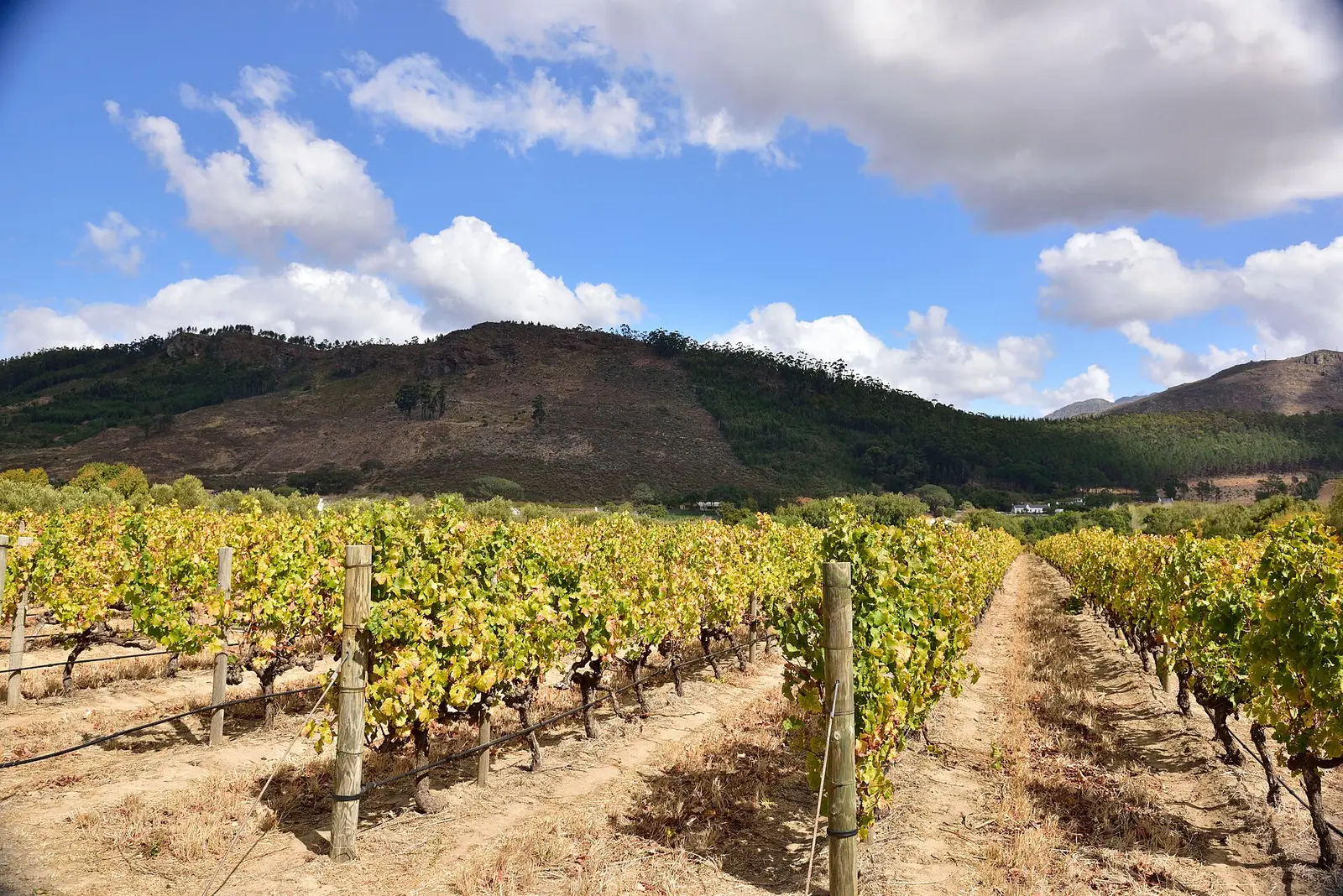
The winelands have a Mediterranean climate with most rain from May to August. A southeasterly wind called the Cape Doctor blows in spring and summer and cools the vineyards.15