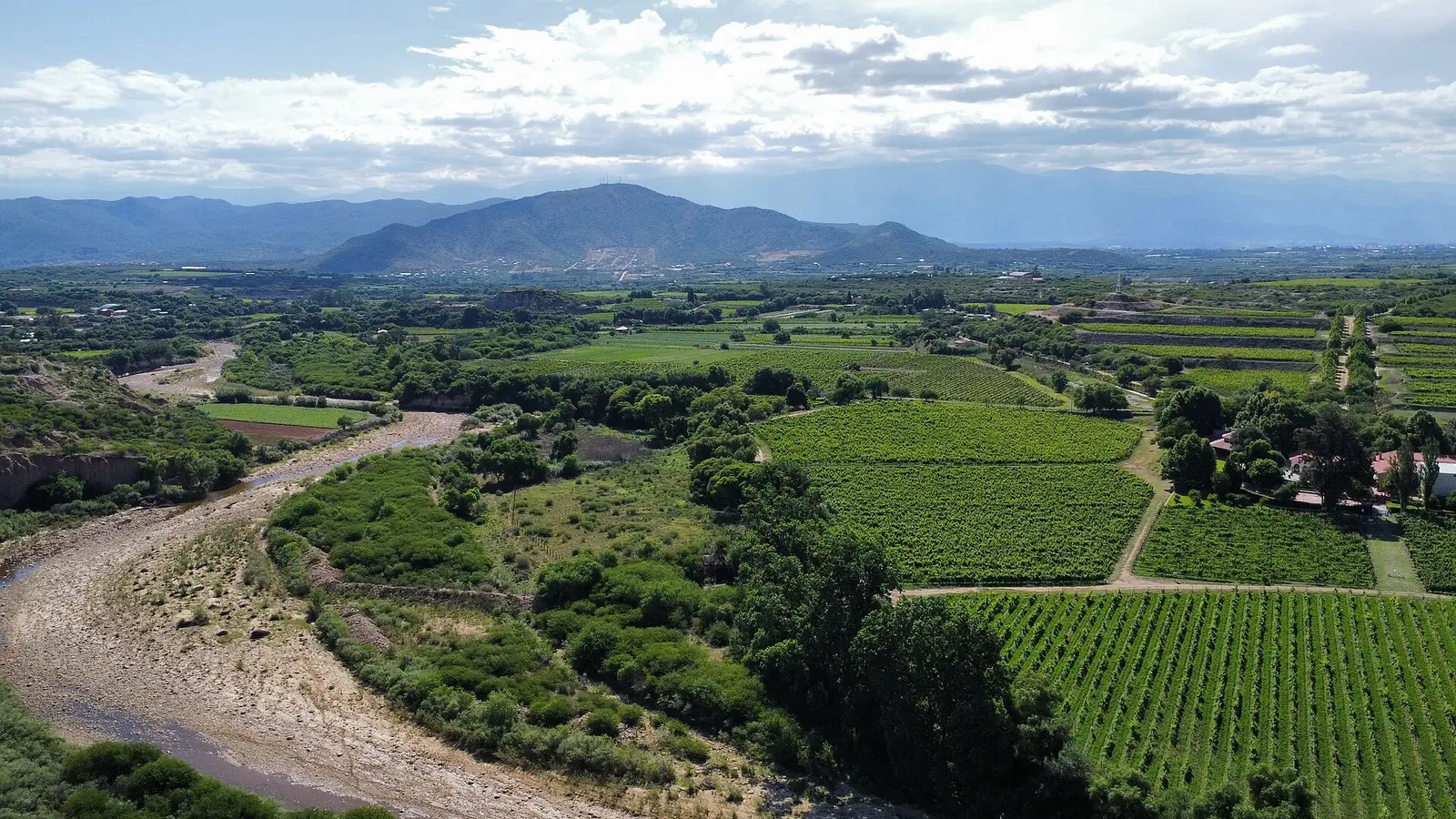
Tarija is Bolivia's wine heartland: valley vineyards at roughly 1,600–2,500 m, Tannat reds, Muscat of Alexandria and the grape spirit singani.
Bolivia is landlocked and dominated by Amazon jungle and the Andes, yet it has a wine industry, based in Tarija near the Argentine border. Many of its vineyards sit in mountain valleys and foothills more than a mile high.1
Sources give different altitudes. GuildSomm puts Tarija's Central Valley at 1,600–2,150 m; The World reported 6,000–8,250 feet; Euronews said most production lies at 1,600–2,000 m, with some crops in hot Andean areas reaching 3,000 m.2,3,4
Accounts of the first vines differ. Los Tiempos says Franciscan, Dominican and Jesuit orders brought viticulture to colonial Charcas, today's Bolivia, in the second half of the 16th century; Euronews credits Jesuit missionaries in the 17th century.2,4,5
More than half of the harvest goes to white wine, table grapes and singani, Bolivia's national grape spirit. Under Bolivian Standard NB 324001 it is distilled from wine made of grapes grown at 1,600 m or higher, and production, distillation and bottling must also happen in traditional zones at that altitude.1,6
Bolivia created a Denomination of Origin for singani in 1992, covering Tarija's Central Valley, the Cinti valleys and areas of La Paz and Potosí. In 2023 the United States recognized singani as a distinctive product of Bolivia, in exchange for Bolivian recognition of Bourbon and Tennessee Whiskey.2,6
At altitude, UV-B radiation rises. A 2021 review says this may push grapes to build flavor-related compounds but can also sunburn bunches, and it stresses that few well-controlled studies exist.7
Bolivia is a tiny producer: about 11,000 acres of vines and roughly 15 million liters of wine in 2018, against 29.3 billion liters worldwide, according to the head of its winemakers' association.1
Recognition
Bolivia's Law 1388 of 2021 declared the Fiesta de la Vendimia Chapaca, Tarija's grape harvest festival based in Uriondo, intangible cultural heritage of the country.8
- Muscat of Alexandria (white): The most planted grape and the base for singani. Euronews reports it makes up 70% of Bolivia's wine crops.2,4
- Tannat (red): A French red planted for altitude: its thick skin copes with intense sun. An Aranjuez Tannat won Bolivia's first grand gold medal, at a 2013 contest in Uruguay.1
- Vischoqueña (red): An old local variety from the Cinti valleys, described as a cross of Muscat of Alexandria and Listán Prieto (Negra Criolla).2,5
- Central Valley of Tarija: The main wine area, at about 1,600–2,150 m, with a semi-arid, mild continental climate and summer rain. Hail is a threat, and a 2005 law required vineyards to take steps against it.2
- Cinti valleys (Camargo): In Chuquisaca, with vineyards up to about 2,400 m. Camargo says it has made singani for over 450 years, with production recorded from 1600.2,5
The Vendimia Chapaca includes a harvest and grape-treading day, wine and singani tastings, artisanal fairs, music and a tourist route through wineries and distilleries. In 2025 it was held on March 1–2.8,9
In the Cinti valley, harvest runs in February and March; grapes go into cane baskets and are pressed by foot. Camargo's national wine fair has coincided with its harvest festival in early March.5
Wineries welcome visitors: a guide at Campos de Solana told NPR it hosted 12,000 visitors in the year before its 2019 report.1
Altitude figures disagree: 1,600–2,150 m (GuildSomm, Central Valley), 6,000–8,250 ft or about 1,830–2,515 m (The World), 1,600–2,000 m for most production with some crops at 3,000 m (Euronews), up to 2,400 m in Cinti (GuildSomm). Search results also showed 2,200–2,850 m and 'highest in the world' claims from retail or blog sites; these were not used, and no source opened verified a world ranking, so the page avoids calling Tarija the highest. The founding date of viticulture differs (second half of the 16th century per Los Tiempos and GuildSomm; 17th century Jesuits per Euronews). Tarija's share of national production (80–97% in snippets) was not confirmed in an opened source and is omitted. The World's article is dated 2017 but its figures read as about 2008–2010; only its altitude and climate lines are used. The UV-B review's antioxidant findings are left out to avoid health framing. Harvest months come from Los Tiempos on Cinti; El País reported the Tarija harvest already advancing by mid-February 2025. Style acidity and Tannat sweetness are not described by sources and are set to 3. The Federal Register site blocked fetching; the same rule was read on govinfo.gov. Bolivian government tourism documents are PDFs and were not opened.
Questions people ask
Can you grow wine in Bolivia?
Yes. Bolivia has about 11,000 acres of vines, mostly around Tarija near the Argentine border, in valleys more than a mile high just north of the Tropic of Capricorn.1,3
What is singani?
Bolivia's national grape spirit. Bolivian rules require grapes grown at 1,600 m or more and production in traditional zones; some categories must use Muscat of Alexandria. A Denomination of Origin was created in 1992.2,6
Sources
- Grown At High Altitudes, Bolivia's Wines Are Rising Stars, NPR (republished by KUNC) (2019). Accessed 2026-11-18.
- Bolivian Wine, GuildSomm (2017). Accessed 2026-11-18.
- Hidden high-altitude treasure, The World (PRX) (2017). Accessed 2026-11-18.
- Bolivian wine: high altitude, high quality and healthy, Euronews (2021). Accessed 2026-11-18.
- Camargo, cuna del vino y el singani, Los Tiempos (2023). Accessed 2026-11-18.
- Addition of Singani to the Standards of Identity for Distilled Spirits (final rule), US Federal Register via govinfo.gov (2023). Accessed 2026-11-18.
- UV-B Radiation as a Factor that Deserves Further Research in Bolivian Viticulture: A Review, South African Journal of Enology and Viticulture (record on FAO AGRIS) (2021). Accessed 2026-11-18.
- Bolivia: Ley Nº 1388 (Fiesta de la Vendimia Chapaca), Lexivox (Bolivian legal texts) (2021). Accessed 2026-11-18.
- La Vendimia 2025 resaltará el aporte de los productores, El País (Tarija) (2025). Accessed 2026-11-18.