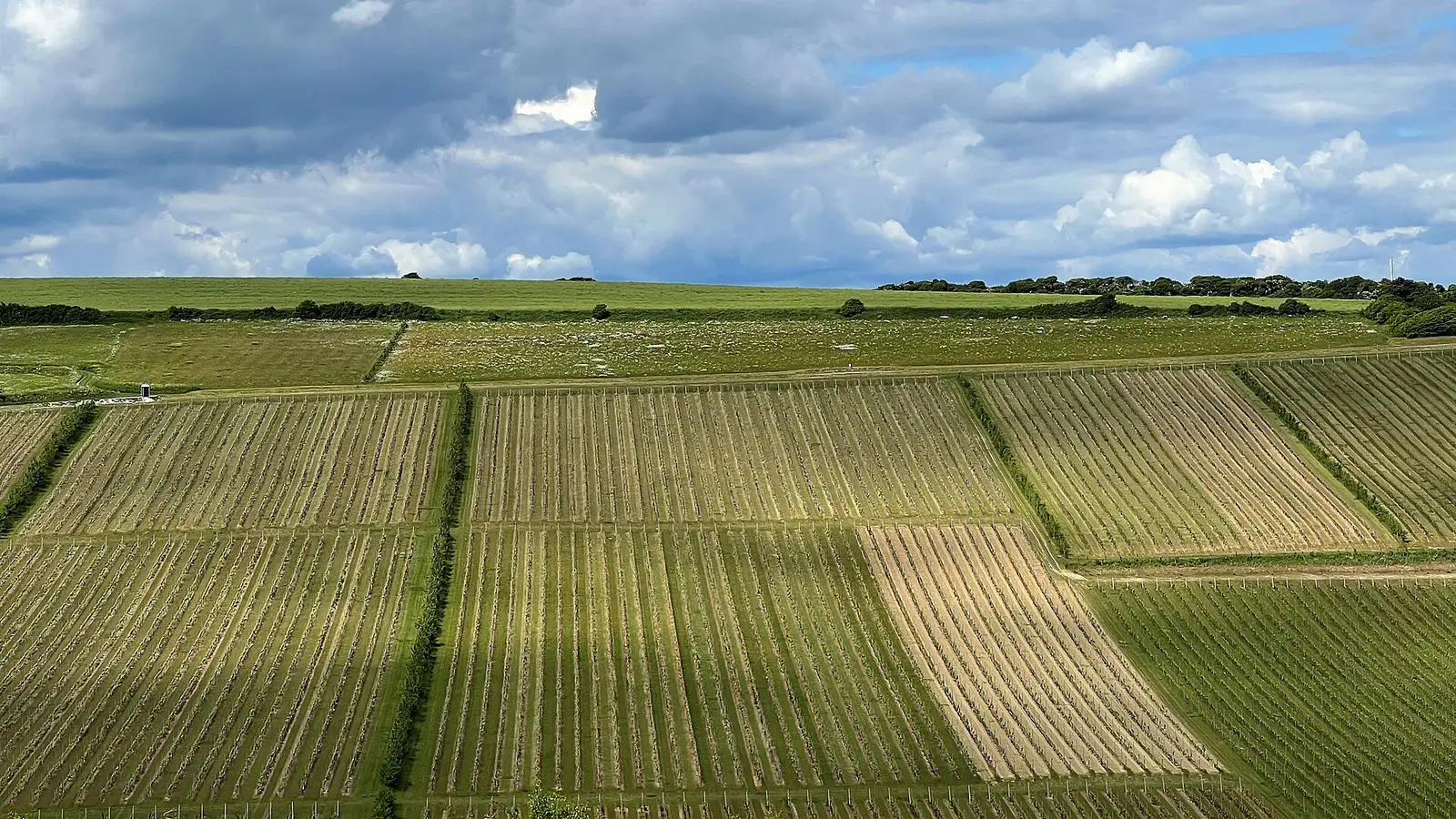
Southern England makes traditional-method sparkling wine from Chardonnay and the Pinots, helped by about 1°C of growing-season warming since the 1980s.
On 17 December 1662 the physician Christopher Merrett read a paper to the new Royal Society describing how winemakers added sugar and molasses to make wine sparkle. He described it several years before Dom Pérignon began his work at Hautvillers in Champagne.1
Growing-season temperatures in the main UK wine regions rose by about 1.0°C between 1981–2000 and 1999–2018. A 2022 study in OENO One says this warming underpinned the sector's rapid growth, which has focused on sparkling wine.2
UK vineyard area grew nearly 400%, from 761 to 3,800 hectares, between 2004 and 2021, and the 2018 vintage set a record of 15.6 million bottles. The same research projects up to a further 1.4°C of growing-season warming in parts of England and Wales by 2040.3
The researchers project Champagne-like growing temperatures across a growing area of England in 2021–2040, and more land suited to still red Pinot Noir. They also warn that early-season frost risk will remain and that growers should not lock into styles that cannot adapt.2,3
Champagne's chalk is often said to run under the Channel into southern England, and WineGB says chalk runs through the North and South Downs. But much English sparkling wine is not grown on chalk: Camel Valley is on slate, and Nyetimber is about two-thirds greensand. Growers disagree on how much chalk matters.4,5
Champagne Taittinger's Domaine Evremond sits near Chilham, outside Canterbury in Kent, on 125 hectares, almost half under vine. Euronews reported in 2025 that south-east England's climate today is comparable to Champagne's about 50 years ago.6
2025 brought what WineGB called the earliest and ripest harvest ever seen in the British Isles, and output rose 55% to over 16.5 million bottles. Heat brings problems too: in 2026 some base wines grew too high in potential alcohol for easy second fermentation, and WineGB sought permission for producers to acidify.7,8,9
Recognition
Sussex holds the UK's first regional Protected Designation of Origin (PDO), which requires a minimum of 15 months in bottle and focuses on the classic Champagne grapes.5
- Traditional-method sparkling (sparkling, crisp): The style that built England's reputation. WineGB calls it complex, elegant and distinctively fresh, and one Hampshire grower credits chalk with fine acidity.4,11
- Cool-climate still white (white, crisp): About a third of English and Welsh wine is still. WineGB says the still whites have naturally lower alcohol and freshness at their core.11,12
- Chardonnay (white): WineGB says Chardonnay thrives in Kent, and it is one of the three classic sparkling grapes in Sussex and Hampshire.5
- Pinot Noir (red): A core sparkling grape in Sussex and Hampshire. Climate projections suggest more of England could suit still red Pinot Noir by 2040.3,5
- Pinot Meunier (red): The third Champagne grape in Sussex and Hampshire. Domaine Evremond's first Classic Cuvée blends 55% Pinot Noir, 35% Chardonnay and 10% Pinot Meunier.5,6
- Kent: The largest region by area, at 1,239 hectares. WineGB says warmer, drier conditions give it an edge, and it makes traditional-method sparkling and a new wave of still wines.5
- Sussex: 1,132 hectares, with chalk on the South Downs. Traditional-method sparkling is its flagship, and it holds the UK's first regional PDO.5
- Hampshire: 426 hectares, with most vineyards in the chalklands of the South Downs. WineGB calls it the coolest of the larger UK wine regions.5
English Wine Week runs in late June. In 2026 vineyards opened for tours, tastings, picnics, sunset tours and concerts, including some estates not normally open.10
Many estates offer tours, tastings and dining, and some have walking routes through the vines with free maps from the cellar door. A few offer stays, from glamping to lodges.10
Harvest usually falls in September and October. Recent hot years have pulled it earlier: in 2026 Gusbourne in Kent picked from August 26 to September 18.7,9
The WineGB 2025 Industry Report is a PDF and was not opened (no downloads), so its figures (e.g. 4,841 ha under vine, a sparkling share near 69%, Chardonnay as most planted) are left out. Area figures differ by definition: WineGB's regions page gives England 4,489 ha, while the Food Standards Agency counted 4,357.66 ha of active vines in 2025 (124,377 hl, over 16.5 million bottles, up 55% on 2024); only regional figures are used in the text. Taittinger's land-purchase year appeared only in search snippets and is omitted. Harvest months rest on news reporting that 2026 ran up to a month earlier than usual; no official 'typical harvest' statement was found. No BBC article on the topic surfaced; Guardian pieces appeared only as excerpts and are not cited. Style body and sweetness are not described by the sources and are set to 3; acidity 4 follows 'distinctively fresh' and 'fine acidity'. The chalk debate is reported as a debate, not settled.
Questions people ask
Can you grow wine grapes in England?
Yes. Growing seasons in the main regions warmed about 1°C between 1981–2000 and 1999–2018, and vineyard area grew nearly 400% from 2004 to 2021. Frost and wet flowering seasons remain risks.2,3
What wine is England known for?
Traditional-method sparkling wine from Chardonnay, Pinot Noir and Pinot Meunier, mostly from Kent, Sussex and Hampshire. About a third of production is still wine.5,12
Sources
- Christopher Merrett and the beginnings of champagne, Royal College of Physicians (history blog) (2017). Accessed 2026-11-18.
- Climate change projections for UK viticulture to 2040: a focus on improving suitability for Pinot noir, OENO One (2022). Accessed 2026-11-18.
- Study predicts growth in UK wine production due to climate change, University of East Anglia via EurekAlert! (2022). Accessed 2026-11-18.
- Chalk talk: the geology of English sparkling wine, The World of Fine Wine (2015). Accessed 2026-11-18.
- Wine Regions, WineGB. Accessed 2026-11-18.
- Why French winemakers are buying up huge swaths of land in Southern England, Euronews (2025). Accessed 2026-11-18.
- WineGB celebrates the start of the growing season with publication of 2025 harvest report and new Green Book, WineGB (2026). Accessed 2026-11-18.
- UK wine production soars in 2025, new data from the Food Standards Agency shows, WineGB (2026). Accessed 2026-11-18.
- Extreme heat pushed English vineyards to harvest grapes up to a month early, Vinetur (2026). Accessed 2026-11-18.
- The A to Z of English Wine Week 2026, WineGB (2026). Accessed 2026-11-18.
- Wine Styles, WineGB. Accessed 2026-11-18.
- Wines, WineGB. Accessed 2026-11-18.