The Bekaa Valley makes most of Lebanon's wine. Château Musar made wine through the 1975–90 civil war, and Baalbek's Temple of Bacchus stands nearby.
Wine in Lebanon long predates the Bekaa's modern estates. A Phoenician wine press at Tell el-Burak, near Sidon on the coast, was in use by at least the 7th century BC, and the Phoenicians spread vineyards to colonies around the Mediterranean.1
Modern Bekaa winemaking began in 1857, when Jesuit monks inherited a 25-hectare plot and planted vines; that estate became Château Ksara. In 1898 the Jesuits found Roman-era caves, about 2 km long, while trying to smoke out a fox.2,3
During the 1975–90 civil war the Bekaa became a thoroughfare and battleground, and production fell. Château Musar missed only one vintage, 1976, when fighting, fuel shortages and blocked roads stopped the harvest.3,4
After Israel's 1982 invasion about 80 hectares of Musar vineyards became a front line, with Syrian and Israeli tanks facing each other across the vines. Bedouin pickers gathered what fruit they could, and trucks still reached the winery at Ghazir, north of Beirut.4,5
In 1984 only two truckloads of grapes got through, one after five days on the road. Serge Hochar made the wine anyway, and that year Decanter named him its first Man of the Year.4,6
War returned in 2024. Al-Monitor reported that Israeli strikes forced Bekaa harvesters into short windows, some vineyards could not be reached, and a strike put Chateau Rayak out of service.7
Lebanon had about five wine producers in 1995 and about 46 by 2023, making roughly 8–9 million bottles a year, with around half exported.5
Recognition
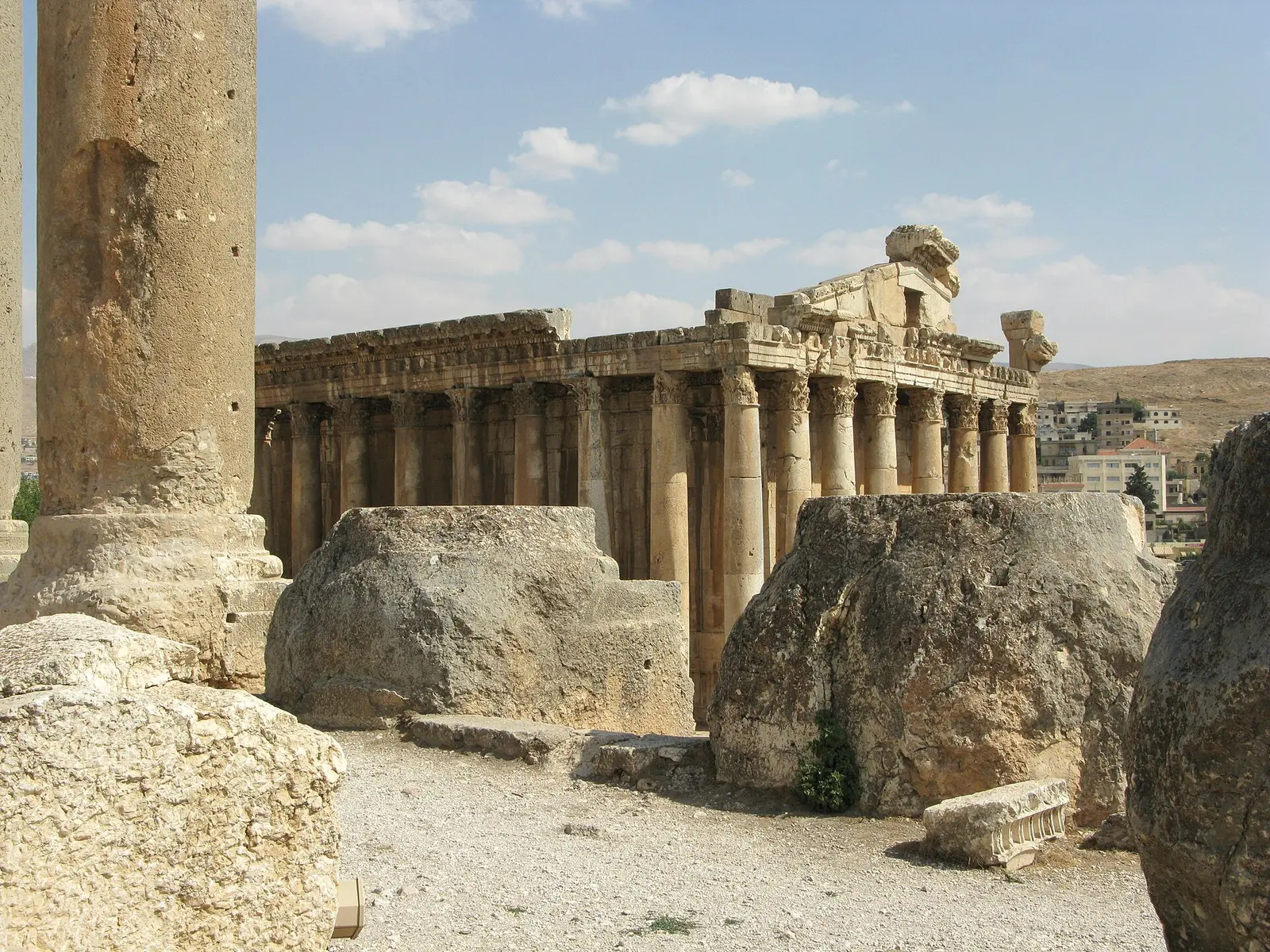
The Roman ruins of Baalbek, in the Bekaa, were inscribed as a UNESCO World Heritage Site in 1984. Their Temple of Bacchus, probably begun under Emperor Antoninus Pius in the 2nd century AD, is about 66 m long with 42 Corinthian columns.3,10
- Bordeaux–Rhône red blend (red): Lebanese reds are mostly blends of Rhône and Bordeaux grapes, such as Cabernet and Syrah. Musar's red blends Cinsault, Cabernet Sauvignon and Carignan.8,9
- Obaideh–Merwah white (white): White wine from the indigenous Obaideh and Merwah grapes, revived by several producers and made by Château Musar.8,9
- Cinsault (red): A core grape in Château Musar's red, alongside Cabernet Sauvignon and Carignan, with Grenache and Mourvèdre in some years.8
- Cabernet Sauvignon (red): Lebanon grows mostly Rhône and Bordeaux grapes, often blended, and a Cabernet–Syrah blend is common.9
- Obaideh and Merwah (white): Indigenous whites that are coming back. Château Musar uses them for its white wine.8,9
Château Ksara runs a roughly 40-minute tour that passes its vineyards, observatory and 19th-century winery and goes into the Roman caves. It is open daily except December 25 and January 1.11
Château Kefraya, Lebanon's second-largest producer, offers daily tours with a train ride through the vineyards. Bradt advises calling wineries ahead to arrange visits.5
Harvest runs from August to October. Check current travel advice first: in 2024 strikes disrupted harvests and closed some Bekaa wineries.5,7
UNESCO's Baalbek page (whc.unesco.org/en/list/294) refused the fetch tool and the built-in browser had no free tab, so the 1984 inscription and temple details are cited to Wikipedia (which cites UNESCO and Sear's Roman Architecture) plus Apollo; Wikipedia notes the temple's link to Bacchus is widely accepted but not certain. The web search budget ran out after the first two files; NYT and Decanter's Musar features could not be read. Musar's wartime story rests on Club Oenologique and Musar's own history page; Apollo says Hochar took Musar to London in 1975, while Club Oenologique ties UK imports to 1976 and Musar dates its UK company to 1979, so no single date is given. Musar's winery is in Ghazir, not the Bekaa; its grapes come from the Bekaa. Altitude ranges are national (900–2,400 m, Somm Journal), not Bekaa-specific. Winery counts differ (about 46 per Bradt 2023, about 50 per Wikipedia). Harvest months come from Bradt's description of Musar's harvest. No source described style body, acidity or sweetness; all set to 3. Grape lists for Musar come from Wikipedia, which cites The Wine Doctor.
Questions people ask
Can you grow wine in Lebanon?
Yes. Lebanon has made wine since Phoenician times, and today the Bekaa Valley, with hot dry summers and chalky soils, produces most of it. Vineyards sit at roughly 900 to 2,400 m.1,5,9
What wine is Lebanon known for?
Red blends of Bordeaux and Rhône grapes, above all Château Musar's Cinsault–Cabernet–Carignan red, plus a revival of native whites, Obaideh and Merwah.8,9
Sources
- 2,600-year-old wine factory unearthed in Lebanon, National Geographic (2020). Accessed 2026-11-18.
- Our Legacy, Château Ksara. Accessed 2026-11-18.
- Ripe histories – winemaking in Lebanon, Apollo (2023). Accessed 2026-11-18.
- Chateau Musar in the war years – a vintage report with a difference, Club Oenologique (2020). Accessed 2026-11-18.
- Lebanon's wine industry, Bradt Guides (2023). Accessed 2026-11-18.
- History, Château Musar. Accessed 2026-11-18.
- Lebanon's wine region wrestles with war, Al-Monitor (with AFP) (2024). Accessed 2026-11-18.
- Château Musar, Wikipedia. Accessed 2026-11-18.
- A New Lens on Lebanon: Why the Country's Wines Are Worth Your Attention, The Somm Journal (2025). Accessed 2026-11-18.
- Temple of Bacchus, Wikipedia. Accessed 2026-11-18.
- Visit Us, Château Ksara. Accessed 2026-11-18.