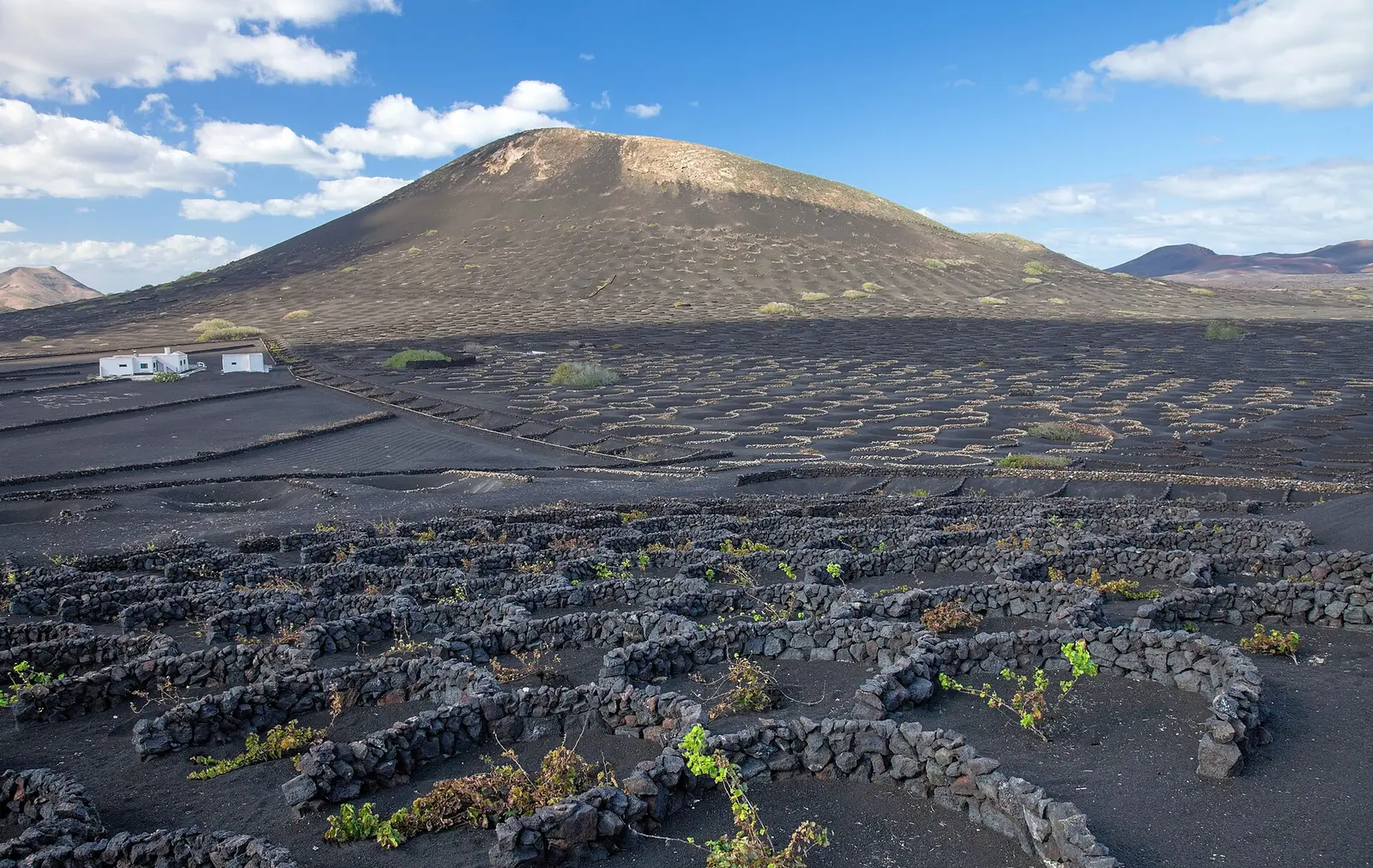
Spain's Canary Islands grow Malvasía and Listán Negro in volcanic soils; Lanzarote's La Geria plants vines in ash pits behind stone walls.
Between 1730 and 1736 eruptions on Lanzarote covered a quarter of the island in lava, including its most fertile soil and 11 villages. The ash, or lapilli, that fell nearby is what later made viticulture possible there.1,2
Lanzarote averages under 150 mm of rain a year, with almost constant trade winds. A layer of black volcanic ash called picón lets rain soak in fast, cuts evaporation and holds dew, while fertile clay or sand lies beneath.3,4
In La Geria growers dig funnel-shaped pits through ash up to 3 m thick to reach the old soil, planting 1–3 vines in each. Semicircular stone walls about 60–70 cm high shield the vines from wind and drifting ash.2,5
No machine fits this system, so all the work is done by hand. Yields are tiny, about 1,000–1,500 kg per hectare by the DO's account, and the average vine is 30 to 50 years old.2,5,6
The DOP Islas Canarias says the islands keep ancestral vines that predate phylloxera, the root louse that devastated vineyards elsewhere. Tenerife holds about 65% of the archipelago's vines, trained in styles from pergolas to braided cordons in the Orotava valley.7,8
Canary wine once reached English literature: 'Canary sack' was a white fortified wine shipped from the islands, and in Shakespeare's Twelfth Night Sir Toby tells Sir Andrew he lacks 'a cup of canary.'9,10
Recognition
Lanzarote was designated a UNESCO Biosphere Reserve in 1993, and La Geria's vineyards are described as a protected area.1
- Malvasía Volcánica white (white, crisp): The DO says Lanzarote's wines stand out for a volcanic, mineral character and relatively high acidity; Malvasía Volcánica wines are also described as markedly fruity.2,11
- Late-harvest Malvasía (sweet): Malvasía Aromática is made dry, semi-dry and sweet, and the DOP says it shows best as naturally sweet late-harvest wine.11
- Malvasía Volcánica (white): Lanzarote's main grape and a natural cross of Malvasía Aromática and Marmajuelo. In 2025 it was the largest variety by volume, at about 550,000 kg.11,12
- Listán Negro (red): The most planted red in the Canaries, doing especially well on Tenerife. Studies suggest it arose in the islands as a cross of Mollar Cano and Palomino Fino.8,11
- Malvasía Aromática (white): Brought to the Canaries in the 15th century and grown mainly on Tenerife and La Palma. Its best wines are naturally sweet late harvests.11
- La Geria, Lanzarote: Between Yaiza and Tías, with the island's largest concentration of vineyards and the deepest ash, which is why growers use pits here.5
- Tenerife: The largest island and main producer. Soils are reddish and organic on Teide's northern slopes and sandy in the south, and trade winds give each vineyard its own microclimate.8
Semana Malvasía, run by the Lanzarote DO, held its 12th edition on November 3–8, 2026, with tastings, pairing dinners and a Sunday route through La Geria's wineries.13
The Canary Wine Route, run by the islands' winemakers' association, lists winery visits, estate visits and guided trips on Tenerife, Gran Canaria, Lanzarote, Fuerteventura and La Palma.14
Lanzarote's producing vineyards covered about 1,890 hectares in 2026, farmed by more than 1,800 growers, and in 2025 they bottled about 1.1 million liters.12
The web search budget ran out after the first two files, so sources were found through known URLs and Wikipedia references. Pit size differs: the DO's island page gives about 3 m wide and 2–2.5 m deep, its environment page 'sometimes more than 2 m' deep, and Wikipedia 4–5 m wide and 2–3 m deep; the text uses depth of ash (up to 3 m) instead. The DOP says the islands preserve 'pre-phylloxera' vines but no opened source states outright that vines are ungrafted or that phylloxera never reached the islands, so the page does not claim that. Vineyard area differs: about 2,000 ha (DO environment page, undated) versus 1,889.13 ha producing (DO statistics, April 2026). The 1730–1736 eruption details and the 1993 Biosphere Reserve status come from Wikipedia (encyclopedia, last resort) because UNESCO's page refused the connection; the DO itself confirms the 1730–1736 eruptions. Canary sack is cited to Wikipedia; Shakespeare's line is checked against the Folger text. No opened source gave harvest months, so harvest_months is empty. Body for both styles and sweetness for Malvasía Volcánica are not described by sources and are set to 3. Listán Negro wine styles are not described by any source opened, so no red style is listed.
Questions people ask
How do vines grow in Lanzarote's volcanic ash?
Growers dig pits through the ash to the buried soil and plant 1–3 vines in each. The ash holds dew and slows evaporation, and low stone walls block the wind on an island with under 150 mm of rain a year.3,4,5
What wine are the Canary Islands known for?
Whites from Malvasía, especially Malvasía Volcánica on Lanzarote, and reds from Listán Negro, the islands' most planted red, mainly on Tenerife.2,11
Sources
- Lanzarote (reached via the La Geria redirect), Wikipedia. Accessed 2026-11-18.
- Lanzarote (La Isla), Consejo Regulador DO Vinos de Lanzarote. Accessed 2026-11-18.
- Clima, Consejo Regulador DO Vinos de Lanzarote. Accessed 2026-11-18.
- Suelo, Consejo Regulador DO Vinos de Lanzarote. Accessed 2026-11-18.
- Entorno, Consejo Regulador DO Vinos de Lanzarote. Accessed 2026-11-18.
- Cultivo, Consejo Regulador DO Vinos de Lanzarote. Accessed 2026-11-18.
- Canary Wine – DOP Islas Canarias, DOP Islas Canarias (AVIBO). Accessed 2026-11-18.
- Isla de Tenerife, DOP Islas Canarias (AVIBO). Accessed 2026-11-18.
- Sack (wine), Wikipedia. Accessed 2026-11-18.
- Twelfth Night, Act 1, Scene 3, Folger Shakespeare Library. Accessed 2026-11-18.
- Variedades, DOP Islas Canarias (AVIBO). Accessed 2026-11-18.
- Estadísticas, Consejo Regulador DO Vinos de Lanzarote (2026). Accessed 2026-11-18.
- Vuelve Semana Malvasía: vino y arte del tres al ocho de noviembre, Consejo Regulador DO Vinos de Lanzarote (2026). Accessed 2026-11-18.
- Canary Wine Route, Asociación de Viticultores y Bodegueros de Canarias (AVIBO). Accessed 2026-11-18.