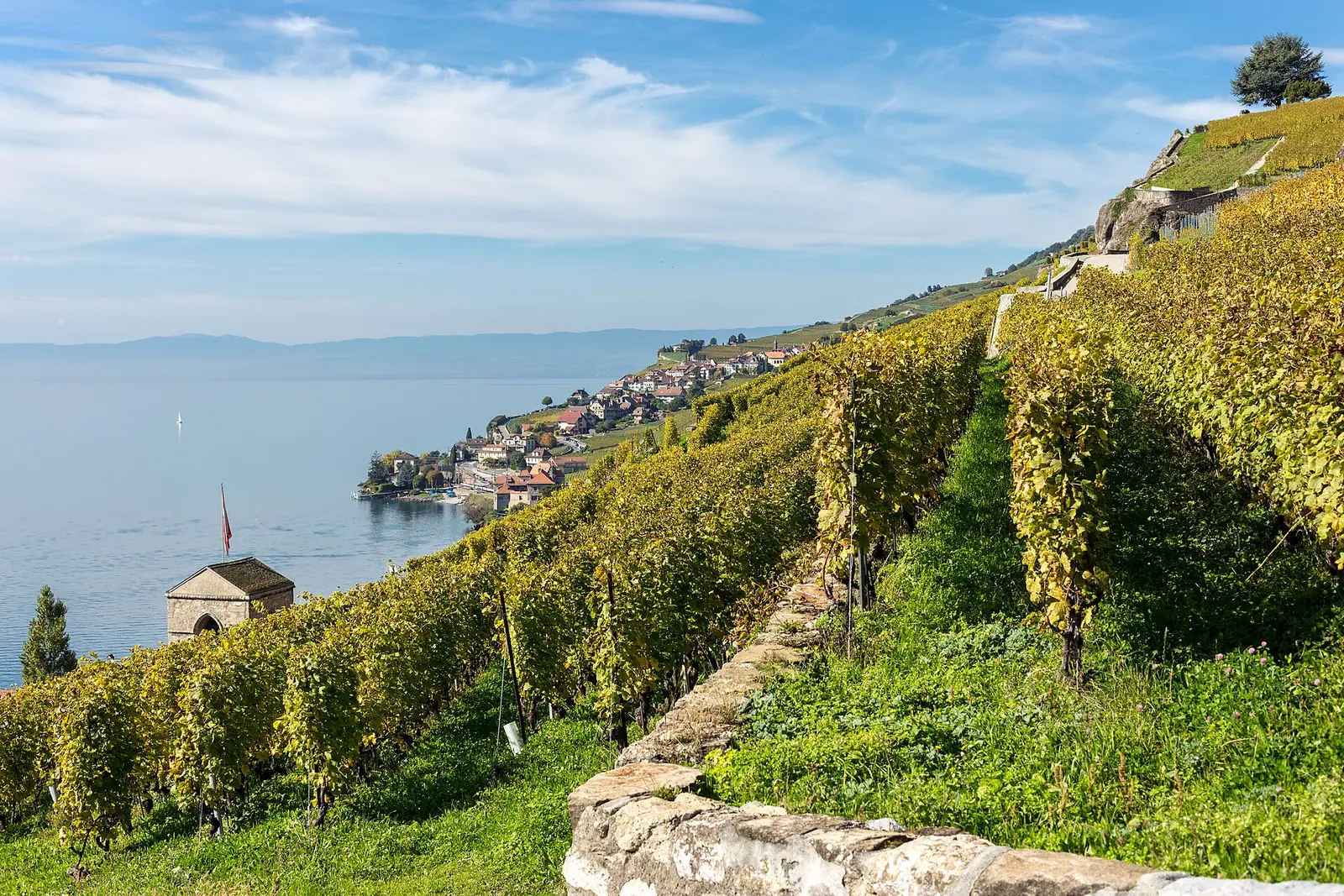
Lavaux is a UNESCO-listed terraced vineyard on Lake Geneva's north shore, about 800 ha planted mostly with Chasselas, first terraced under monks.
Lavaux's vineyards cover the steep, south-facing slopes between its villages and Lake Geneva for about 30 km. The average gradient runs from 13° to 43°, and about 10,000 terraces make farming possible.1,2
The terraces rest on 400 to 450 km of walls built from local stone, mostly cleared from the vineyards or blasted, and usually bonded with lime mortar tinted to match. The walls also drain rainwater and carry stairs between plots.1
Swiss Wine Promotion describes a 'three suns' effect here: direct sunlight, light reflected off the lake and heat stored in the stone walls.3
In 1079 the bishops of Lausanne gained authority over the area. In the 12th century they gave land to Cistercian abbeys, whose monks cultivated steep sites such as the Dézaley; two monastic estates, the Clos des Moines and Clos des Abbayes, now belong to the city of Lausanne.2
Building plans threatened the slopes in 1972, and Franz Weber founded 'Save Lavaux'. Vaud voters approved protection in 1977, again with 81% in 2005 after it was repealed, and a stronger counter-proposal in 2014.4
Harvest on these slopes is mostly done on foot, with pickers carrying crates on their backs. Growers also use tracked carts, monorails, small funiculars and, on the hardest plots, helicopters.5
Recognition
UNESCO inscribed Lavaux on the World Heritage List on 28 June 2007 as a living cultural landscape, recognizing its long, still active winegrowing tradition, well-preserved villages and terraces adapted to hard terrain.7
- Lavaux Chasselas (white): Vaud is known for fresh, fruity Chasselas. In Lavaux, sandier soils tend to give lighter wines and clay-rich soils more powerful ones, from round Villette to rich Saint-Saphorin.3,6
- Plant Robert red (red): A rare local red from a Gamay-related grape, described as spicy and peppery.6
- Chasselas (white): About three-quarters of Lavaux's vines. The site's managers describe its wine as restrained, neutral and balanced, able to gain honey and beeswax notes over decades.6
- Plant Robert (red): A local red said to descend from Gamay vines brought from Beaujolais, spicier and more peppery today. It was saved from disappearing in 1966.6
- Dézaley Grand Cru: A 54-hectare grand cru inside the Lavaux AOC, on slopes Cistercian monks farmed in the 12th century.2,6
- Calamin Grand Cru: At 16 hectares, the smaller of Lavaux's two grand crus.6
- Lavaux AOC: 798 hectares, with six production areas: Lutry, Villette, Epesses, Saint-Saphorin, Chardonne and Vevey-Montreux. Soils are glacial moraine from the Rhône glacier.2,6
The Route des Grands Crus is an easy 2.8 km trail between Épesses and Rivaz with eight stations, open year-round and taking about 90 minutes. Trains stop at Cully, Épesses, Rivaz, Chexbres and Puidoux.8
Certified guides lead visits from May to October, including a heritage tour on the Lavaux Panoramic tourist train from Vevey.9
Caves Ouvertes Vaudoises, on Pentecost weekend, opens winegrowers' cellars for tastings, with free guided vineyard walks from Cully and Chexbres.10
Swiss grapes are typically ready in September, and the Lavaux association notes that warmer temperatures have brought harvests earlier over the years.5,11
UNESCO's own page (whc.unesco.org/en/list/1243) refused the fetch tool, and the built-in browser had no free tab, so the inscription is cited to the site's official management association (Lavaux Patrimoine mondial), which gives the date, session and the four values ICOMOS identified. The web search budget ran out after the first two files, so no BBC or Swissinfo reporting was found. Area figures differ: 798 ha AOC (2022), 'more than 800 ha', about 800 ha (Swiss Wine), and Wikipedia's 830 ha and 898 ha core zone; the page uses the AOC figure. Wall length is given as about 450 km and 'more than 400 km' by the same association. The 'three suns' idea is reported as Swiss Wine Promotion's description. Wikipedia says Benedictine and Cistercian monasteries shaped the terraces from the 11th century; the association names only Cistercians from the 12th century, after the 1079 grant, so only that is stated. Harvest month (September) comes from Swiss Wine's general statement for Swiss vineyards. Maison Lavaux, the interpretation centre, closed permanently in June 2026 and is not listed. No source gave body, acidity or sweetness levels for the styles; all set to 3.
Questions people ask
Why is Lavaux a UNESCO World Heritage Site?
UNESCO listed it in 2007 as a living cultural landscape: about 10,000 terraces on slopes up to 43°, walls running 400–450 km, preserved villages and a winegrowing tradition dating to medieval monks.1,2,7
What wine is Lavaux known for?
Chasselas, about three-quarters of the vines, with grand crus at Dézaley and Calamin. It is a restrained white that can gain honeyed notes with age.6
Sources
- Les murs de vigne de Lavaux, Lavaux Patrimoine mondial. Accessed 2026-11-18.
- Lavaux et ses patrimoines, Lavaux Patrimoine mondial. Accessed 2026-11-18.
- Vaud wine region, Swiss Wine Promotion. Accessed 2026-11-18.
- Lavaux, Fondation Franz Weber. Accessed 2026-11-18.
- Au cœur des vendanges, Lavaux Patrimoine mondial (2023). Accessed 2026-11-18.
- Terroirs et cépages, Lavaux Patrimoine mondial. Accessed 2026-11-18.
- Inscription de Lavaux au patrimoine mondial de l'UNESCO, Lavaux Patrimoine mondial. Accessed 2026-11-18.
- Route des Grands Crus de Lavaux, Lavaux Patrimoine mondial. Accessed 2026-11-18.
- Visites guidées, Lavaux Patrimoine mondial (2026). Accessed 2026-11-18.
- Caves Ouvertes Vaudoises, Lavaux Patrimoine mondial. Accessed 2026-11-18.
- At the heart of the harvest, Swiss Wine Promotion. Accessed 2026-11-18.