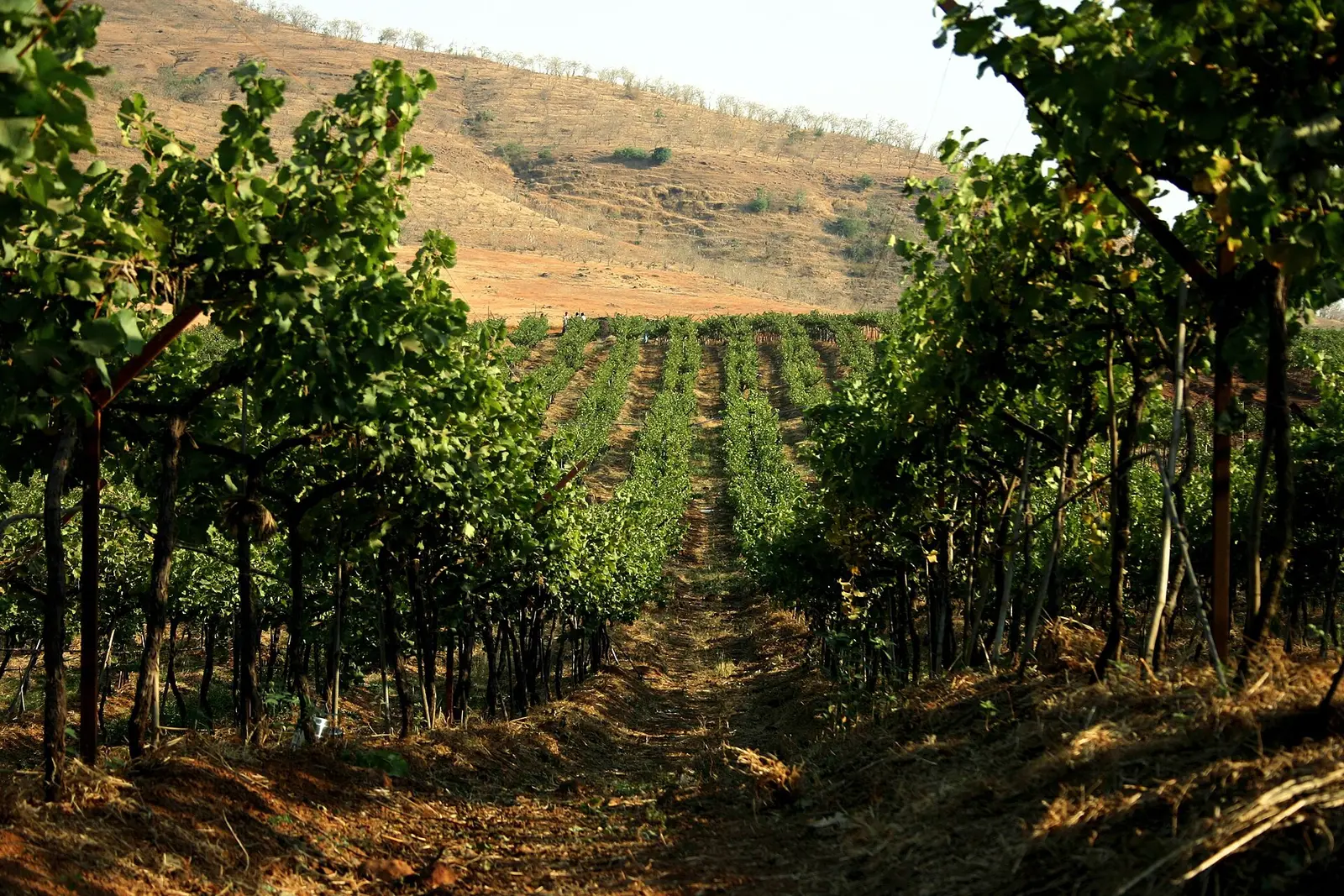
Nashik, in Maharashtra, is India's best-known wine region: tropical vineyards near 20°N, pruned twice a year, harvested from about January to April.
Most of India's grapes grow in a hot tropical belt between about 15° and 20° N, covering Nashik and other districts of Maharashtra plus parts of Andhra Pradesh and Karnataka. It holds about 70% of the country's grape area.1
Growers there prune twice a year but harvest once. A back pruning in March–May cuts canes to single buds to grow new wood, and a forward pruning in October–November sets up the fruit.1
The National Research Centre for Grapes advised against forward pruning earlier than October or later than November because of unfavourable weather. Its director listed soil and water salinity and drought among the region's main problems.1
Nashik's vineyards lie on hilly ground at about 610–730 m. Days average about 26°C and nights fall to 7–8°C, according to the region's geographical indication filing as summarized by Wikipedia.2
Rajeev Samant, who studied at Stanford and worked in California, visited his family's land in Nashik in 1994 and decided to grow wine grapes there. Sula Vineyards made its first vintage in 1999 and is described as the first winery in Nashik.3,4
Nashik is known as the 'Wine Capital of India', and Wikipedia counts 52 wineries in the district as of 2015. The Oxford Companion to Wine is cited for the nickname.2,5
- Chenin Blanc (white): One of the wine grapes crushed in India's tropical region, and among the varieties Sula pioneered around 2000.1,4
- Sauvignon Blanc (white): Grown in the Nashik valley. A Sula Sauvignon Blanc won silver at the 2011 Decanter World Wine Awards.2,6
- Shiraz (red): Listed among the Nashik valley's grapes, and made by Sula.2,6
Harvest runs from late January to mid-April. India's main grape harvest falls in March and April.1,2
Sula reported about 300,000 visitors in the year before late 2023. Entry costs Rs 600 on weekdays, including a six-wine tasting, and Rs 1,000 on weekends.7
SulaFest, a wine and music festival held at the Nashik vineyard from 2008, ended after its 2020 edition. Sula now hosts live music on about 30 weekends a year.7
Thin file. The web search budget ran out after the first two files, and many useful pages could not be fetched (The Hindu, Hindu BusinessLine, Indian Express, Financial Express, Business Standard); the official GI Journal is a PDF and was not opened, so altitude, temperatures, harvest window and the 52-winery count are cited to Wikipedia, which summarizes it. The double-pruning practice is well sourced (FAO chapter by the director of India's National Research Centre for Grapes), but that chapter is undated and probably about 2000; it describes India's tropical grape region overall, mostly table grapes, not Nashik wine alone. No opened source used the phrase 'new latitude', so the page does not. Maharashtra's state wine policy, Nashik's share of national production and current winery counts were not verified and are left out. The Ecologist's claim that Sula's first plants came from smuggled seeds was not used. Visitor numbers come from Indian Wine Academy reporting Sula's own figures. No source described body, acidity or sweetness for the styles; all set to 3. No heritage listing was found.
Questions people ask
Can you grow wine grapes in India?
Yes. In the tropical belt between about 15° and 20° N, growers prune vines twice a year, in March–May and October–November, and harvest once, mainly from January to April.1,2
Sources
- Grape production in India, FAO, in Grape Production in the Asia-Pacific Region. Accessed 2026-11-18.
- Nashik valley wine, Wikipedia. Accessed 2026-11-18.
- Sula Vineyards, Sula Vineyards. Accessed 2026-11-18.
- Sula Vineyards, Wikipedia. Accessed 2026-11-18.
- Indian wine, Wikipedia. Accessed 2026-11-18.
- India's 'Napa Valley': Sula vineyard pioneers eco-friendly wine in an emerging market, The Ecologist (2012). Accessed 2026-11-18.
- SulaFest is out but Sula charges ahead with Wine Tourism, Indian Wine Academy (2023). Accessed 2026-11-18.