The people
- Khoikhoi: Khoikhoi pastoralists, including the Goringhaiqua and Goarchoqua, used the Table Bay area as seasonal grazing land. After wars with the Dutch they lost land and independence, and many ended up working on settler farms alongside enslaved people.1,2
- Enslaved people at the Cape: About 60,000 enslaved people were brought to the Cape between 1652 and 1807, from present-day Angola and Ghana at first, and later from India, Indonesia, Madagascar and Mozambique. They worked the wine and wheat farms of the southwestern Cape.2
- Dutch East India Company (VOC) officials and free burghers: Jan van Riebeeck led the VOC expedition that reached Table Bay in 1652. From 1657 the company released some employees from their contracts to farm their own land as free burghers.1,3
- French Huguenots: Protestant refugees from France reached the Cape from 1688. The Dutch government at the Cape gave them land in a valley later called Franschhoek, French Corner.4,5
The story
The Dutch East India Company (VOC) set up a refreshment station at the Cape in 1652 to supply fresh food to its ships. Jan van Riebeeck, its first commander, planted a vineyard in 1655.3,6
On 2 February 1659 the first wine was made from Cape grapes. Larger plantings followed at Roschheuvel, today's Bishopscourt in Cape Town.6
Farming took Khoikhoi land. In 1657 the VOC gave free burghers farms along the Liesbeeck River, and Khoikhoi herders feared losing their pastures and water. On 19 May 1659, Khoikhoi led by Doman raided the settlers' herds, starting the first Khoikhoi–Dutch War.1,7
The war ended in a stalemate in 1660 with no return of seized cattle. The Khoikhoi accepted continued European occupation of the peninsula, and van Riebeeck had hedges of bitter almond and thorn bushes planted to keep Khoikhoi cattle off company land.1,7
The first enslaved people arrived at the Cape in 1658. By 1710, adult enslaved people outnumbered adult colonists by up to three to one, and their labor ran the colony's wine and wheat farms.2
Simon van der Stel, commander from 1679, was granted Constantia in 1685, more than 2,454 hectares. He bought his first enslaved man, Jan van Oldenburg from Bengal, in 1680 and owned 22 people by 1686.8
Huguenot refugees did not bring winemaking to the Cape, which had made wine for decades before them. About 138 arrived in 1688, and by 1692 there were 201 among 856 free burghers; a few, such as the de Villiers brothers, had known vine-growing in France.5,6
Under the Cloete family, owners from 1778 to 1885, Constantia's wine became known internationally, and it was sent to Napoleon in exile on St Helena. Iziko says the Cloetes used enslaved labor extensively; slavery at the Cape finally ended in 1838.2,8
How we know
Slave records survive in part: the Cape Slave Register, begun in 1816, names some of the people enslaved at Groot Constantia, though the 120 to 150 men who rebuilt the estate around 1778 are unrecorded.8
Groot Constantia's displays include archaeological finds and a late 18th-century drawing of an enslaved man named Jacob with Hendrik Cloete Senior.8
Historians of the Huguenots use the VOC's opgaafrolle tax censuses and published archive transcriptions, such as H.C.V. Leibbrandt's, to count settlers and their farms.5
Dates for the first Cape vines differ slightly: Wines of South Africa gives 1655, while Britannica says Dutch settlers brought Rhine grapes as early as 1654.6,9
What it left behind
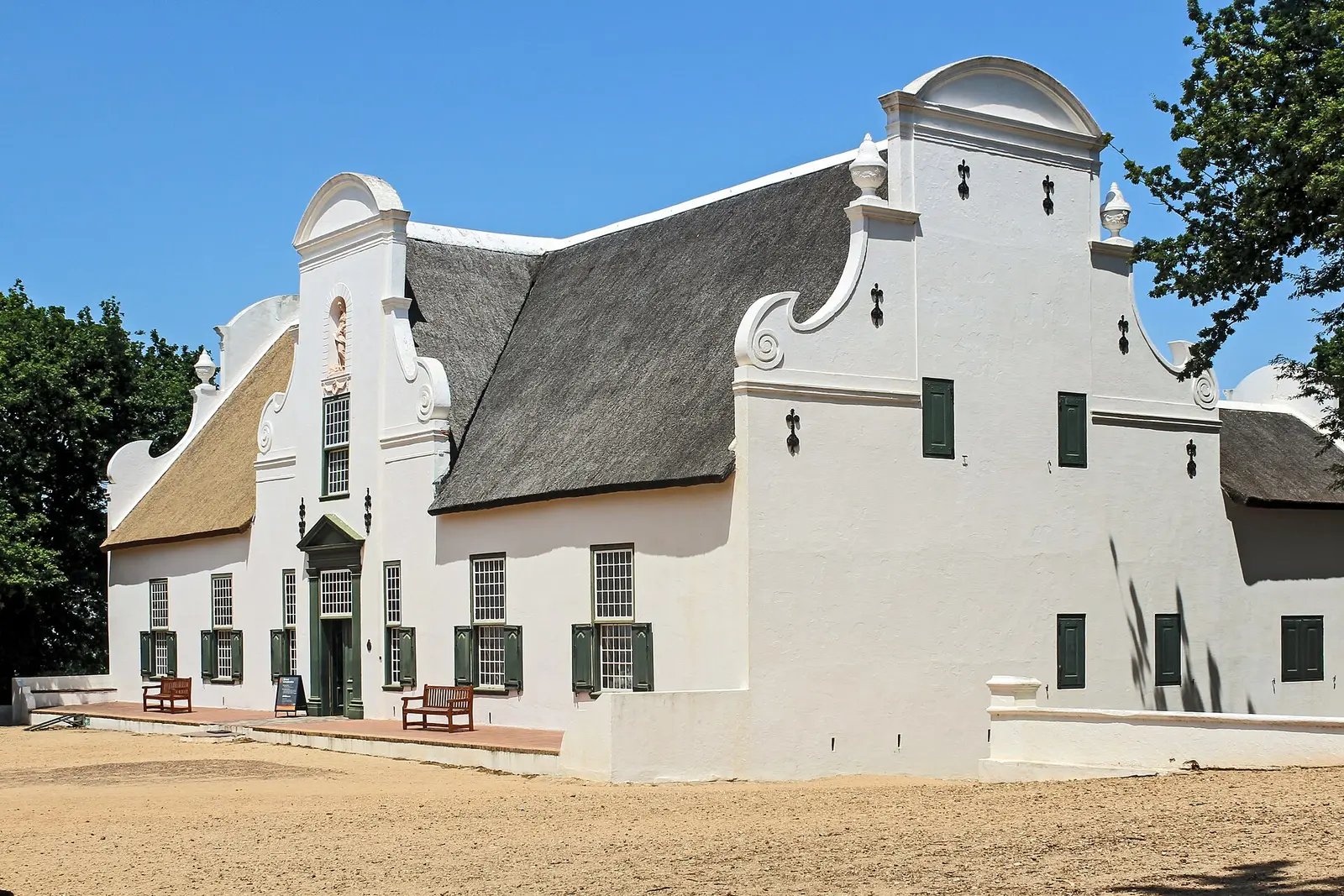
Groot Constantia in Cape Town, run by Iziko Museums, has a furnished manor house, a wine museum in the old cellar and an orientation center with exhibits on the Khoi-San, wine history and slavery.8
The Huguenot Memorial Museum and Huguenot Monument in Franschhoek tell the Huguenots' story in the wider history of refugee movements.10
Many Franschhoek wine farms still carry their original French names.4
The place today: South Africa.
Questions people ask
When was the first wine made in South Africa?
On 2 February 1659, at the Dutch East India Company's station at the Cape, from vines Jan van Riebeeck had planted in 1655.6
Did the French Huguenots start South African wine?
No. Wine had been made at the Cape for about three decades before they arrived from 1688. A few Huguenots had grown vines in France, and the industry grew after they settled.5,6
Who worked the early Cape vineyards?
Largely enslaved people brought from Africa and Asia, plus Khoikhoi who had lost their land and independence. Slavery at the Cape did not finally end until 1838.1,2
What is Groot Constantia?
One of South Africa's oldest commercial wine farms, granted to Simon van der Stel in 1685. It is now an Iziko museum that covers wine history and the enslaved people who worked there.8
Sources
- Establishment of the Cape and its impact on Khoikhoi and Dutch, South African History Online (2011). Accessed 2026-11-18.
- History of slavery and early colonisation in South Africa, South African History Online (2011). Accessed 2026-11-18.
- Jan van Riebeeck, South African History Online (2026). Accessed 2026-11-18.
- Franschhoek, Western Cape, South African History Online (2026). Accessed 2026-11-18.
- SA wine history: On the Impact of the French Huguenots, Winemag.co.za (2018). Accessed 2026-11-18.
- Three Centuries of Cape Wine, Wines of South Africa (WOSA). Accessed 2026-11-18.
- The Khoikhoi carry out a series of raids on the free burghers' herds, South African History Online. Accessed 2026-11-18.
- Groot Constantia, Iziko Museums of South Africa. Accessed 2026-11-18.
- Wine: History, the spread of viticulture, Encyclopaedia Britannica (2026). Accessed 2026-11-18.
- Huguenot Memorial Museum, Huguenot Memorial Museum, Franschhoek. Accessed 2026-11-18.