The people
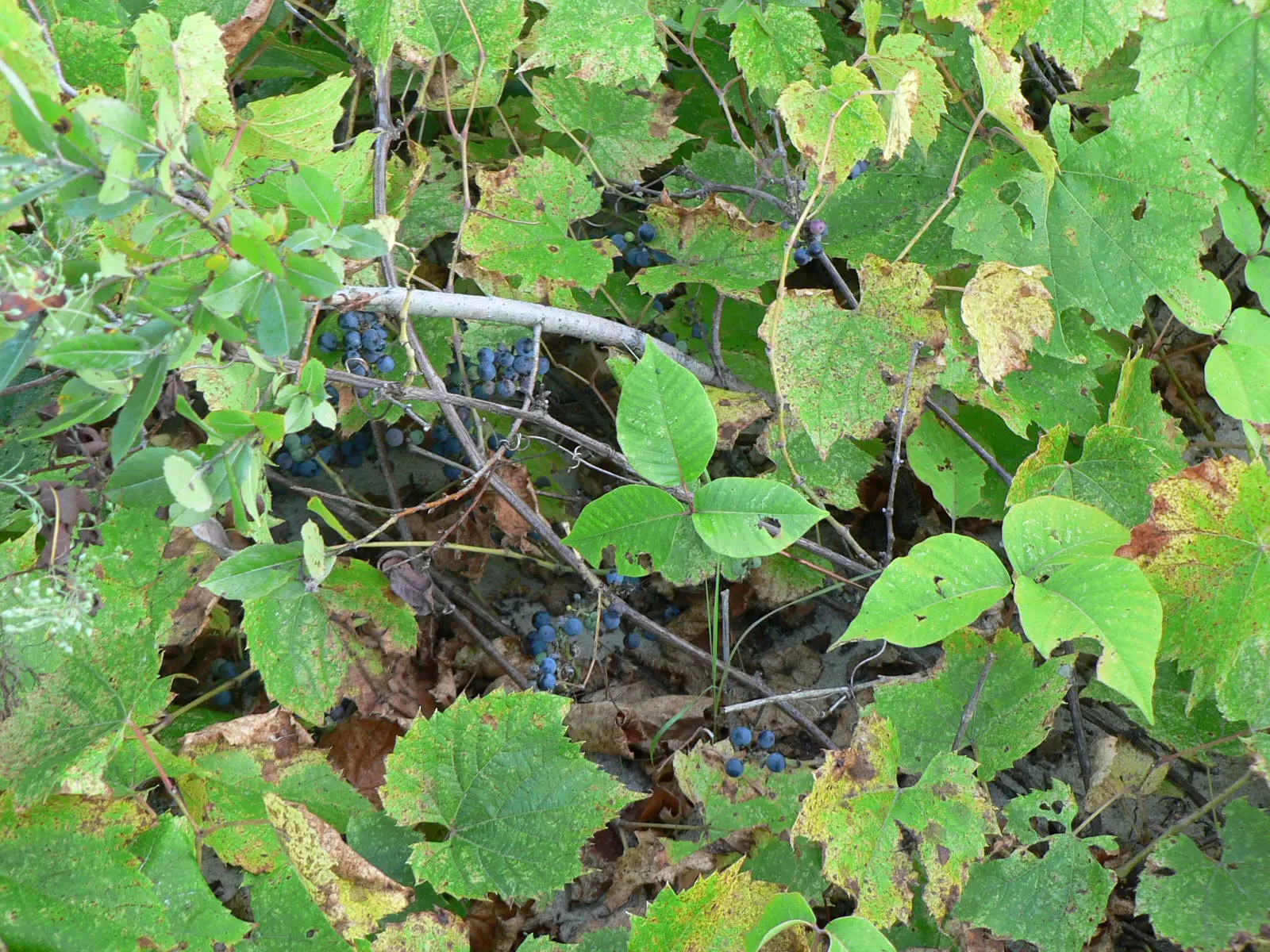
- Omaha: Ethnobotanist Melvin Gilmore recorded in 1913 that the Omaha ate riverbank grapes (Vitis riparia) fresh in season and dried them for winter.1
- Cherokee: Cherokee food records list muscadines and fox grapes eaten raw and used to make juice and dumplings, and a drink of grape juice mixed with pokeberry juice, sugar and cornmeal.2,3
- Mohegan: Gladys Tantaquidgeon, a Mohegan anthropologist, recorded Mohegan uses of fox grape leaves in her studies of Mohegan and Delaware medicine (1928, 1972).3
- Peoples of Tsenacomoco: John Smith wrote in 1612 that the Indigenous people of the Virginia coast called a cherry-sized grape 'Messaminnes'. English colonists settled along the James River in Tsenacomoco, and in 1622 its peoples attacked the settlements up and down the river.4,5
The story
Grapes (genus Vitis) include about 60 to 80 species native to the north temperate zone. Several of the economically important ones are North American: the fox grape (V. labrusca), the summer grape (V. aestivalis) and the muscadine (V. rotundifolia) of the southeastern United States.6
Indigenous nations ate wild grapes. Records gathered in the Native American Ethnobotany Database describe Omaha families drying riverbank grapes for winter, and Cherokee cooks making muscadine and fox grape juice and dumplings.1,2,3
At Jamestown, John Smith wrote in 1612 that wild vines grew in great abundance, climbing the tallest trees but bearing few grapes. The colonists made nearly 20 gallons of wine from 'hedge grapes', and he judged a thick-juiced local grape less pleasant as wine.4
The Virginia Company pushed reforms to diversify the colony beyond tobacco, but planters making quick profits from tobacco resisted. In 1621 council member George Thorpe reported that he had planted vines at the college site, land set aside for a school for Indigenous people.5
Thomas Jefferson's 1807 planting of 287 vines of 24 European varieties at Monticello failed. Growing European Vitis vinifera in eastern North America was virtually impossible until black rot and phylloxera could be controlled. After that failure Jefferson turned more toward native vines such as the fox grape and the scuppernong.7
The scuppernong, a bronze-green muscadine, is called the first grape actively cultivated in the United States. Its name, given in 1811, comes from the Algonquian askuponong, 'place of the askupo' (the sweet bay tree).8
Native grapes built a wine industry. In 1840 North Carolina was the leading winemaking state in the country, and in the early 1900s Paul Garrett's sweet Virginia Dare became one of the most popular wines in the United States.8
How we know
The Indigenous uses on this page come from 20th-century ethnobotanical studies, such as Gilmore on the Omaha (1913) and a 1975 University of Tennessee thesis on Cherokee wild-plant foods, compiled in BRIT's Native American Ethnobotany Database.1,2
John Smith's A Map of Virginia (1612) is an early written record of wild grapes on the Virginia coast and of an Indigenous name for one of them, 'Messaminnes'.4
Diaries and letters record early scuppernong wine. In 1817 a traveler on Roanoke Island wrote that residents made good wine for themselves but little for export, and in 1823 Jefferson ordered a 30-gallon barrel of it.8
What it left behind
Grape phylloxera, an insect native to the eastern United States, reached Europe in the mid-19th century and nearly destroyed the grape and wine industries of France, Italy and Germany. European vines were saved by grafting onto resistant rootstocks of native eastern American vines.6,9
Fox grape varieties gave rise to the Concord and other 'slipskin' grapes, used for table grapes, jelly, juice and kosher wines.6
The University of Minnesota's wine grape breeding program, begun in the mid-1980s, uses hardy, disease-resistant selections of Vitis riparia, Minnesota's native grape. It has released cold-climate varieties such as Frontenac (1995) and Marquette (2006).10
North Carolina named the scuppernong its state fruit in 2001. Monticello's restored vineyards, replanted in 1985 and 1993, grow European varieties grafted onto pest-resistant native rootstock.7,8
The place today: United States.
Questions people ask
Did Native Americans make wine from wild grapes?
The records used here describe grapes eaten fresh, dried for winter, and made into juice, drinks and dumplings. None of them describe fermenting grapes into wine, so this page does not claim it either way.1,2,3
Why did early European grapevines fail in eastern North America?
Monticello's historians say growing European vinifera there was virtually impossible until modern methods could control black rot and phylloxera, a root louse.7
What is a scuppernong?
A bronze-green variety of the muscadine grape (Vitis rotundifolia), North Carolina's state fruit. Its name comes from an Algonquian word meaning 'place of the sweet bay tree'.8
How did American grapes save European wine?
When phylloxera from the eastern United States devastated European vineyards in the 19th century, growers grafted their vines onto resistant American rootstocks.9
Sources
- Native American Ethnobotany Database: Vitis riparia uses (citing Gilmore 1913, A Study in the Ethnobotany of the Omaha Indians), Botanical Research Institute of Texas (BRIT). Accessed 2026-11-18.
- Native American Ethnobotany Database: Vitis rotundifolia uses (citing Perry 1975, Food Use of 'Wild' Plants by Cherokee Indians), Botanical Research Institute of Texas (BRIT). Accessed 2026-11-18.
- Native American Ethnobotany Database: Vitis labrusca uses (citing Perry 1975; Hamel and Chiltoskey 1975; Tantaquidgeon 1928, 1972), Botanical Research Institute of Texas (BRIT). Accessed 2026-11-18.
- A Map of Virginia. With a Description of the Countrey, the Commodities, People, Government and Religion (1612), Encyclopedia Virginia, Virginia Humanities (primary document) (1612). Accessed 2026-11-18.
- Sir George Yeardley (bap. 1588–1627), Encyclopedia Virginia, Virginia Humanities. Accessed 2026-11-18.
- Grape, Encyclopaedia Britannica (2026). Accessed 2026-11-18.
- Vineyards (Thomas Jefferson Encyclopedia), Thomas Jefferson Foundation, Monticello (1998). Accessed 2026-11-18.
- Scuppernong Grape, NCpedia, State Library of North Carolina (from the Encyclopedia of North Carolina, UNC Press) (2006). Accessed 2026-11-18.
- Grape phylloxera, Encyclopaedia Britannica (2026). Accessed 2026-11-18.
- Grape breeding at the University of Minnesota, University of Minnesota (Minnesota Hardy). Accessed 2026-11-18.