The people
- Spanish Franciscan and Jesuit missionaries: Franciscan friars needed wine for the Catholic mass and planted vineyards at California's missions, and Jesuits made the first wine in Mexico's Parras Valley in 1594, according to accounts of the region.1,2,3
- California Native peoples: Historians describe the mission vineyards as built on the unfree, forced labor of California Native peoples, who planted, pruned and harvested the vines but had very limited access to the wine.1,4
- Indigenous peoples of colonial Chile, including the Mapuche: In 16th-century Chile, encomienda holders forced most of the Indigenous population into gold mines, and vineyards spread on irrigated land, pushing out Indigenous crops; the historian Hernán Cortés Olivares names Mapuche communities on the frontier among the new consumers of wine and brandy.5
The story
After Columbus, Europeans carried grape growing to the Americas. Spanish missionaries took viticulture to Chile and Argentina in the mid-16th century and to Baja California in the 18th.6
A 2007 DNA study of old vines from Argentina, Bolivia, Chile, Peru and the United States found that most matched two Spanish grapes, Muscat of Alexandria and Listán Prieto, or were their offspring. The authors called the two the major founders of early American viticulture.7
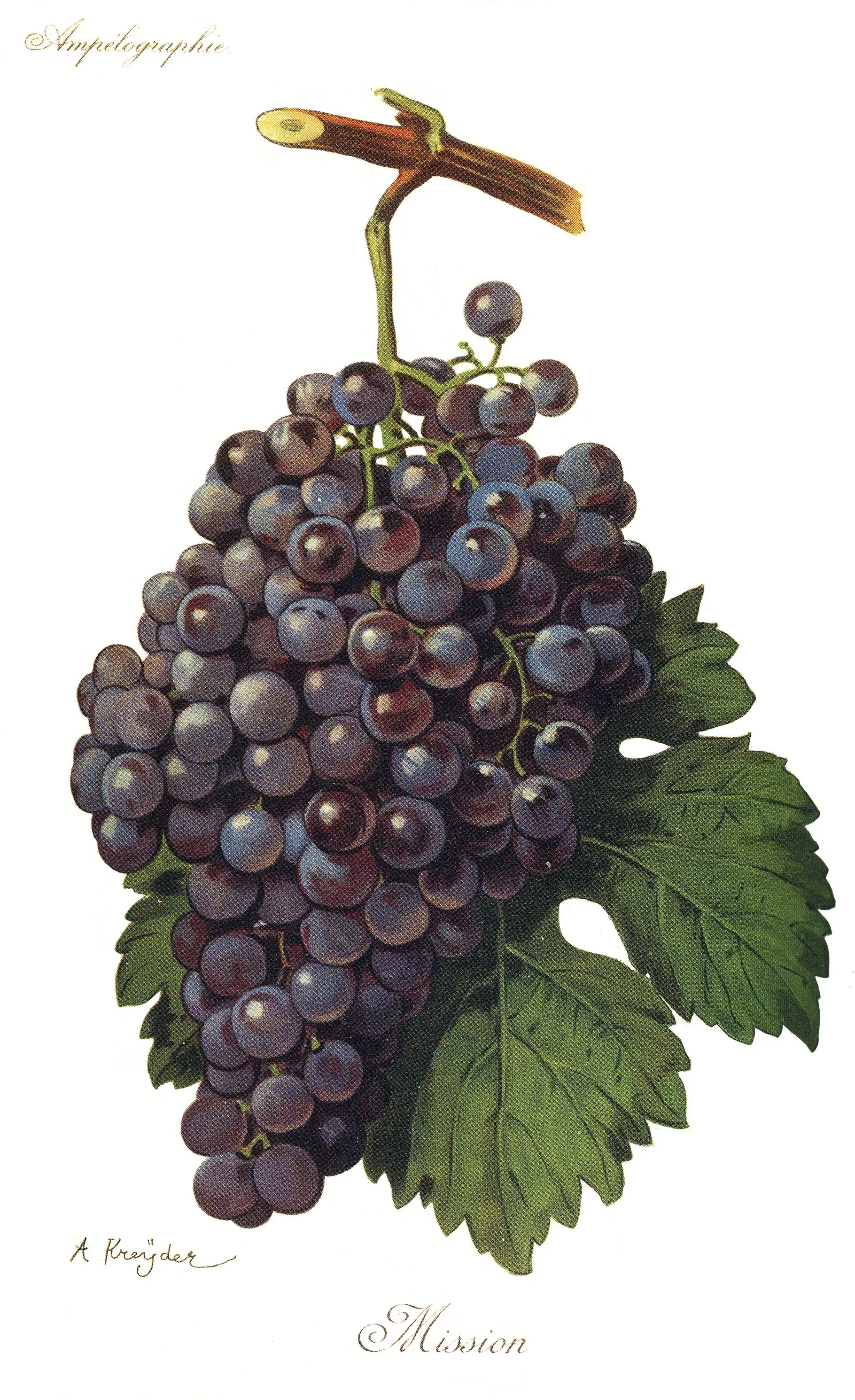
Listán Prieto goes by many names in the Americas: Mission in California, País in Chile, Criolla Chica in Argentina and Rosa del Perú in Peru. Once grown across Castile, it is now rare in mainland Spain but survives in the Canary Islands.7,8
In northern Mexico, Spaniards reached the Parras Valley in 1567 and found wild vines and springs. Jesuits made the region's first wine in 1594, and Casa Madero, often called the oldest winery in the Americas, dates its continuous history to 1597.2,3
In Chile, early vineyards were planted in the Elqui Valley on the estates of the conquistador Francisco de Aguirre and other Spanish settlers. Aguirre boasted of his first harvest in 1553, and wine and brandy from Copiapó, Elqui and Limarí were soon shipped to Peru.5
Grape brandy became a pillar of the colonial economy. Peruvian producers dominated supply to the silver-mining city of Potosí, where brandy made up 21.4% of imports in 1733 and 30.6% in 1793. That brandy tradition is the root of pisco, which both Peru and Chile claim.9
In Alta California, Franciscan friars made Native people plant vineyards, gardens and grain fields. By the early 19th century more than 60% of the missions had vineyards, and those at San Juan Capistrano or San Gabriel likely made California's first vintages by the mid-1780s.1
Spanish rules barred California Native people from freely drinking wine, and wine outside the mass was prohibited to them. In Chile, Cortés Olivares writes that Indigenous mine workers were given alcohol as part of their labor rations.1,4,5
How we know
Genetic fingerprinting (DNA markers) of old vineyard samples in five countries matched Mission, País and Criolla Chica to the Spanish variety Listán Prieto.7,8
Colonial records survive: in 1556 the town council of La Serena, Chile, listed two large vineyards, those of Francisco de Aguirre and Pedro de Cisternas.5
A Franciscan visitor to the Parras estate in 1777, Fray Agustín de Morfi, described a cellar stocked with wine and brandy and an estate of about 3 million vines.3
Trade figures for Potosí, compiled by the historian Enrique Tandeter and cited by Pablo Lacoste and colleagues, show how large the colonial brandy trade grew in the 18th century.9
DNA analysis of the Mother Vine at Mission San Gabriel shows it is a cross between Spanish Listán Prieto and a native California grape, Vitis girdiana.10
What it left behind
Casa Madero, at Hacienda San Lorenzo near Parras de la Fuente in Coahuila, Mexico, offers guided tours of its vineyard and cellars. The Madero family bought the estate in 1893 and restored the old church built by the missionaries.2,3
The Mother Vine, about 250 years old, still grows at Mission San Gabriel in San Gabriel, California. Since 2020 local winemakers have used its grapes to recreate Angelica, a sweet, brandy-fortified mission wine, and mission staff acknowledge the Indigenous labor behind the vineyards.10
In Chile's Elqui Valley, the village once called La Greda, after the clay used for wine and brandy jars, was renamed Pisco Elqui by law in 1936.9
País fell out of favor in Chile in the 19th century, but old bush vines are being used again: Miguel Torres launched a País sparkling wine in 2010, and other producers have followed.11
The place today: Argentina.
Questions people ask
What is the oldest winery in the Americas?
Casa Madero in Parras de la Fuente, Mexico, is often called the oldest. It dates its continuous history to 1597, and Jesuits made the first wine in the Parras Valley in 1594.2,3
Is the Mission grape the same as País and Criolla Chica?
Yes. DNA work published in 2007 showed that Mission (California), País (Chile), Criolla Chica (Argentina) and related vines are the Spanish variety Listán Prieto.7,8
Who did the work in the California mission vineyards?
California Native people. Historians describe it as unfree, forced labor under the Franciscan missions, and Native workers were barred from freely drinking the wine they made.1,4
How is pisco connected to colonial wine?
Pisco is a brandy distilled from wine made with criollo grapes, a tradition that began under Spanish colonization. Peru and Chile both claim it; Chile set legal limits for it in 1931 and Peru in 1991.9
Sources
- What's in a Bottle? Conquest and the Origins of California Wine, American Historical Association, Perspectives on History (2023). Accessed 2026-11-18.
- The legacy of Casa Madero, the Americas' oldest winery, Mexico News Daily (2024). Accessed 2026-11-18.
- Casa Madero, Atlas Obscura (2023). Accessed 2026-11-18.
- Wine Was a Tool of Conquest: California's Hidden Multi-Ethnic History of Winemaking, PBS SoCal (Lost LA) (2022). Accessed 2026-11-18.
- El origen, producción y comercio del pisco chileno, 1546-1931, Universum (Talca) 20(2): 42–81 (2005). Accessed 2026-11-18.
- Wine: History, the spread of viticulture, Encyclopaedia Britannica (2026). Accessed 2026-11-18.
- Determining the Spanish origin of representative ancient American grapevine varieties, American Journal of Enology and Viticulture 58(2): 242–251 (2007). Accessed 2026-11-18.
- Researchers Uncover Identity of Historic California Grape, Wine Spectator (2007). Accessed 2026-11-18.
- Pisco y toponimia: impacto de las rutas del aguardiente en el desarrollo de nombres y lugares geográficos en Chile, Perú y Argentina, Idesia (Arica) 32(3) (2014). Accessed 2026-11-18.
- Raise a glass of Angelica as LA's oldest wine is resurrected, LAist (2025). Accessed 2026-11-18.
- Why Chile's 'forgotten' ancestral grape is due a second renaissance, The Drinks Business (2026). Accessed 2026-11-18.