The people
- Roman agricultural writers: Columella names Marcus Cato the Censor as the man who first taught agriculture to speak Latin, followed by writers including Varro and Vergil.1
- People of Pompeii: Pompeii was a commercial Roman town buried by the eruption of Vesuvius in 79 CE. Many middle- and lower-class Romans ate their meals outside the house.2,3
- Soldiers and households of Vindolanda: At the fort of Vindolanda in northern Britain, a commander's household kept written accounts of wine, beer and food around AD 97–105.4
The story
Pliny the Elder wrote that vine growing came to the Romans at a comparatively recent period, after they had first worked only their fields.5
Cato's farming manual ranks the vineyard first among types of farm, as long as it yields plenty of good wine. It lists the presses, vats and jars a vineyard estate needs.6
Cato also gives a recipe for 'Greek wine', made with sea water or salt, and advises sealing the jars about 30 days after harvest, once fermentation is done.6
Pliny ranked Falernian wine from Campania among the very best and said none ranked higher in his day. He complained that its growers had begun to care more about quantity than quality.7
Pompeii had at least 80 thermopolia, street counters that served hot food and drink. At one on Via dell'Abbondanza, jars set into the counter held spiced wine, cereal soups and legumes, served with focaccia, olives, eggs and cheese.3,8
On one Pompeii counter, a painted shrine shows Bacchus, god of wine, beside Mercury, god of trade, and the household gods.8
Wine went north with the army. An account from Vindolanda lists wine, sour wine and Celtic beer, and sets wine aside for a religious festival on 24 June.4
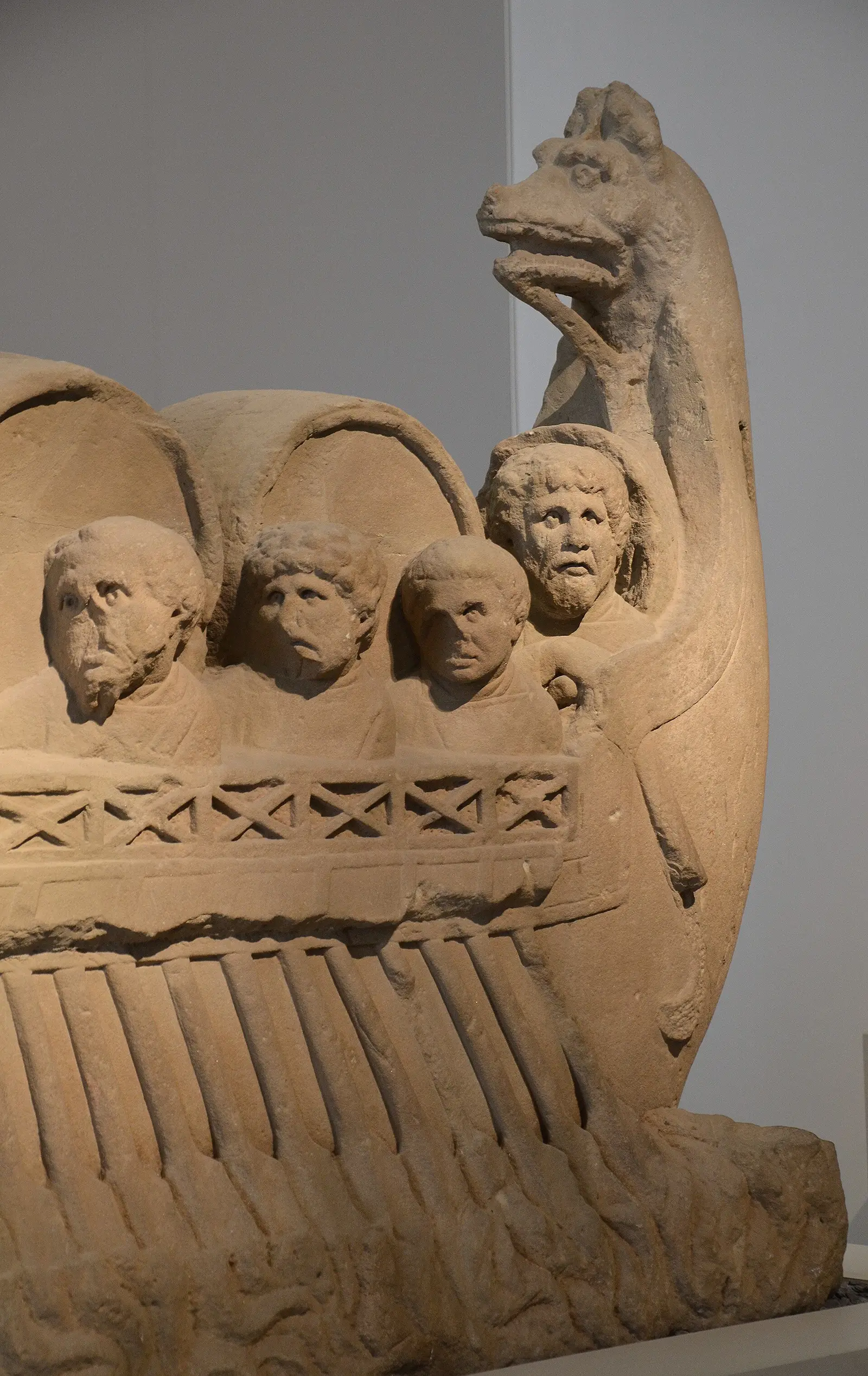
The Romans began growing vines on the Moselle, and Germany's winegrowing goes back to them. Rowing ships carried wine barrels as far as Gaul and other parts of Germania.9
How we know
Roman farm writers survive in print: Cato's De Agricultura and Columella's De Re Rustica are both available in public-domain Loeb translations.1,6
The Regio V thermopolium, found in a never-before-excavated part of Pompeii, kept its painted counter with storage jars built into the masonry.3
Vindolanda tablet 190, an inked wooden tablet dated AD 97–105, is a household account probably kept by an enslaved clerk. Its reading of Massic wine, which Pliny counted among Italy's well-regarded wines, is uncertain.4,7
The Neumagen wine ship, a stone sculpture of a boat loaded with wine barrels from a wine merchant's tomb of about 220 CE, was found in 1878.9
Amphorae for wine and other goods were made in great numbers during the Roman Empire. Because they carried goods, they turn up widely across the ancient eastern Mediterranean world.10
What it left behind
Pompeii is a UNESCO World Heritage Site. Since 1994, the archaeological park and the Mastroberardino winery have replanted 15 vineyard plots inside the ancient city, including the Foro Boario, making a wine called Villa dei Misteri.2,11
The Regio V thermopolium at Pompeii opened to visitors on 12 August 2021. The park has also created tour routes on the history of winemaking around Vesuvius, including the vineyards of Villa Regina at Boscoreale.3,12
The original Neumagen wine ship is in the Rheinisches Landesmuseum in Trier. A floating replica, the Stella Noviomagi, is moored at Neumagen-Dhron, often called Germany's oldest wine village.9,13
Tablet 190 from Vindolanda is now held by the British Museum.4
The place today: Italy.
Questions people ask
What did Roman writers say about vineyards?
Cato ranked the vineyard first among farm types if it gave plenty of good wine. Pliny ranked the wines of Italy and praised Falernian from Campania.6,7
What was a thermopolium?
A Roman street counter serving hot food and drink. Pompeii had at least 80. Jars in the counter held spiced wine, soups and legumes for quick meals.3,8
Did the Romans bring wine to Germany?
Yes. The Romans began growing vines on the Moselle, and Germany's winegrowing traces back to them. The Neumagen wine ship of about 220 CE shows barrels carried by boat.9
Can you see vineyards at Pompeii today?
Yes. About 1.5 hectares of vines grow on 15 plots inside ancient Pompeii, replanted since 1994 by the park with the Mastroberardino winery.11
Did Roman soldiers get wine?
Accounts from the fort of Vindolanda in Britain list wine and sour wine alongside Celtic beer, around AD 97–105.4
Sources
- De Re Rustica, Book I (Loeb Classical Library, 1941), LacusCurtius, University of Chicago (1941). Accessed 2026-11-18.
- Archaeological Areas of Pompei, Herculaneum and Torre Annunziata, UNESCO World Heritage Centre. Accessed 2026-11-18.
- From the 12th August the Thermopolium of Regio V is opening to the public, Archaeological Park of Pompeii (2021). Accessed 2026-11-18.
- Tab.Vindol. 190: Account of Cerialis household, Roman Inscriptions of Britain. Accessed 2026-11-18.
- The Natural History, Book XVIII, Chapter 5 (trans. John Bostock and H. T. Riley), Perseus Digital Library, Tufts University (1855). Accessed 2026-11-18.
- De Agri Cultura, sections 1–52 (Loeb Classical Library, 1934), LacusCurtius, University of Chicago (1934). Accessed 2026-11-18.
- The Natural History, Book XIV, Chapter 8: Fifty kinds of generous wines (trans. John Bostock and H. T. Riley), Perseus Digital Library, Tufts University (1855). Accessed 2026-11-18.
- Along the streets of Pompeii, Archaeological Park of Pompeii. Accessed 2026-11-18.
- Roman Wine Ship of Neumagen, Wines of Germany (Deutsches Weininstitut). Accessed 2026-11-18.
- Amphora, Encyclopaedia Britannica (2026). Accessed 2026-11-18.
- XIX Edition of the Harvest in the Pompeii vineyards, Archaeological Park of Pompeii (2018). Accessed 2026-11-18.
- Villa Romana and the Vineyards of Villa Regina in Boscoreale, Archaeological Park of Pompeii (2024). Accessed 2026-11-18.
- Rhineland Federal State Museum (Rheinisches Landesmuseum Trier), Trier Tourismus und Marketing. Accessed 2026-11-18.