The people
- Bishops and monasteries: Oz Clarke writes that a mix of bishops and monasteries played an important role in keeping wine going into the Middle Ages, and that the first monastery was probably at Trier on the Mosel in the early 4th century.1
- The Avignon popes: The popes settled in Avignon in the 14th century, and under Pope John XXII the nearby village of Châteauneuf became a summer residence of the papacy.2
- Religious orders at Lavaux: In 1079 the bishop of Lausanne received land from Emperor Henry IV, which religious orders then cleared and terraced for vines above Lake Geneva.3
- Order of St. John of Jerusalem: After the fall of Acre in 1291, Kolossi Castle in Cyprus served as the Grand Commandery of the Knights of the Order of St. John of Jerusalem, who made and exported a sweet wine called 'vin de Commanderie.'4
The story
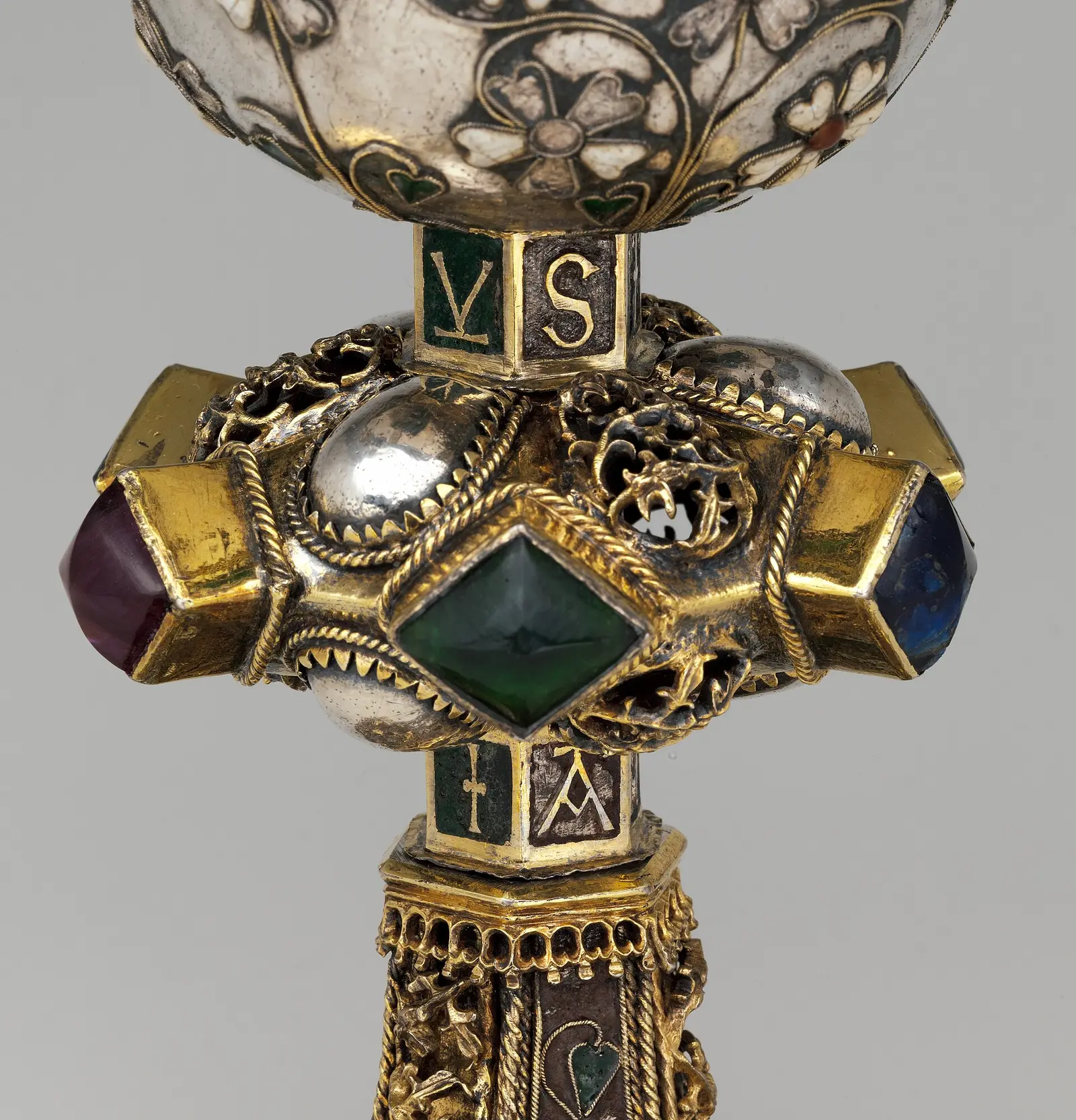
The Catholic Catechism ties the Eucharist to wine as 'fruit of the vine' and 'work of human hands.' It links it to Melchizedek's bread and wine, the 'cup of blessing' at the Passover meal and the wine at Cana.5
Church law still requires wine for the Mass. Canon 924 says the sacrifice is offered with bread and with wine mixed with a little water, and that the wine must be natural, from the fruit of the vine, and not spoiled.6
Oz Clarke cautions that the idea that the Church kept vineyards only to make Eucharist wine is just partly true. Tithes paid in wine and gifts of wine were common too.1
In Burgundy, the Climats association says monks set the rules of winegrowing and production between the 9th and 12th centuries. Clos de Vougeot's model of a walled plot tied to a monastic cellar later spread to abbey vineyards in Germany, Switzerland, Spain and Portugal.7
Monks also carried vines between regions. Cistercians who came from Clairvaux to Kloster Eberbach in 1136 brought vines with them, and Pinot noir from Burgundy became the Rheingau's first successful wine export.8
At Lavaux in Switzerland, documents attesting vine growing date to the 11th century. The site says the presence of religious orders made the clearing and terracing of the slopes possible.3
The Châteauneuf-du-Pape growers credit the popes' move to Avignon with revealing the area's vineyards. Its wine was raised to the rank of 'Vin du Pape,' which opened doors at Europe's royal courts.2
After the French Revolution, vineyards owned by the nobility and the clergy in Burgundy were confiscated and sold to merchants, traders and growers.7
How we know
The 1907 Catholic Encyclopedia sets out what counted as valid altar wine: the 'pure juice of the grape naturally and properly fermented,' white or red, sweet or dry. It rules out wine turned to vinegar or pressed from unripe grapes.9
The same entry records that grape spirit could be added during fermentation to keep weak altar wines from souring in transport, provided total alcohol stayed at or below 18 percent.9
Written records help date this history: Eberbach dates its 1730 cabinet cellar from a carpenter's bill, and Burgundy's 'climat' names first appear in writing in 1584, in a document about Clos de Bèze.7,8
What it left behind
Lavaux was inscribed on UNESCO's World Heritage List in 2007. It is Switzerland's largest single-block vineyard, with about 450 km of walls and more than 10,000 terraces.3
Châteauneuf-du-Pape calls itself France's first wine AOC (1936). Its growers' bottle, used since 1937, bears a papal tiara above the keys of Saint Peter.2
Kolossi Castle, 14 km west of Limassol, is open to visitors. Commandaria, the sweet wine named for the Knights' Grande Commanderie, is still made in 14 villages from late-harvested, sun-dried Mavro and Xynisteri grapes.4,10
Questions people ask
What kind of wine does the Catholic Church require for Mass?
Canon law says the wine must be natural, from the fruit of the vine, and not spoiled, with a little water mixed in. Older guidance allowed red or white, sweet or dry.6,9
Did the Church save winemaking in Europe after Rome fell?
It helped. Oz Clarke says bishops and monasteries played an important role in keeping wine going into the Middle Ages, though tithes and trade mattered as much as the Eucharist.1
Why is it called Châteauneuf-du-Pape?
The village became a summer residence of the papacy under Pope John XXII during the 14th-century Avignon papacy, and its wine became known as 'Vin du Pape.'2
Sources
- History of wine in 100 bottles: Monasteries – Clos de Vougeot, Decanter China (from The History of Wine in 100 Bottles) (2017). Accessed 2026-11-18.
- History, Châteauneuf-du-Pape appellation (chateauneuf.com). Accessed 2026-11-18.
- Lavaux, patrimoine mondial de l'UNESCO, Lavaux Patrimoine mondial. Accessed 2026-11-18.
- Kolossi Medieval Castle, Deputy Ministry of Tourism, Cyprus (Visit Cyprus). Accessed 2026-11-18.
- Catechism of the Catholic Church, paragraphs 1333–1344, The Holy See. Accessed 2026-11-18.
- Code of Canon Law, Book IV, canons 879–958, The Holy See (1983). Accessed 2026-11-18.
- Historic timeline, Association des Climats du vignoble de Bourgogne. Accessed 2026-11-18.
- The Monastery of Eberbach, Wines of Germany (Deutsches Weininstitut). Accessed 2026-11-18.
- Altar Wine (The Catholic Encyclopedia, vol. 1), New Advent (1907). Accessed 2026-11-18.
- Commandaria, Deputy Ministry of Tourism, Cyprus (Visit Cyprus). Accessed 2026-11-18.