The people
- Abu Nuwas: Al-Hasan ibn Hani al-Hakami, known as Abu Nuwas (c. 756–c. 815), wrote khamriyyat, or wine poems, set in Baghdad high society at the height of the Abbasid caliphate.1
- Omar Khayyam: Omar Khayyam was born around 1048 in Nishapur and died there in the 1120s or early 1130s; sources differ on the year. He was a mathematician, astronomer and philosopher, and quatrains (rubaiyat) are attributed to him.2,3
- Hafez of Shiraz: Hafez was a 14th-century Persian poet who lived and is buried in Shiraz. His ghazals were collected in a Divan, probably after his death, and editions vary widely in the number of poems.4,5
The story
Arabic literature has a long tradition of wine poetry, and Abu Nuwas is its best-known voice. His publisher calls him the leading bacchic poet of the classical Arabic canon, both loved and reviled for his poems on Baghdad nightlife and his satires of religion and the clergy.1,6
The Stanford Encyclopedia of Philosophy finds three uses of wine in the quatrains attributed to Khayyam: a literal intoxicant that eases suffering, a mystical image of divine love, and a kind of wisdom that helps one accept that life is brief.2
The same entry says Khayyam was not a Sufi in the traditional sense and that the mystical reading of his wine is held by a minority of scholars.2
Hafez's poems use wine and the tavern alongside love, faith and attacks on hypocrisy. Because mystics had shaped Persian poetic vocabulary, his wine and love images can be read both as lyric and as mystical.5
Islamic studies scholar William Chittick, drawing on Annemarie Schimmel, argues that in Sufi poetry 'wine is wine' and also a sign of divine love. He writes that the Sufi masters followed Islamic law and avoided wine as they avoided other forbidden things.7
Mystical poets also wrote wine odes. The Persian poet and scholar Jami wrote a commentary on Ibn al-Farid's Arabic 'Wine Song' (Khamriyyah) and defended its wine imagery as a language for divine love against critics among the religious scholars.7
Edward FitzGerald's English version of 1859 made the quatrains attributed to Khayyam famous in the West. The Stanford entry says it fixed a Western image of Khayyam tied to Victorian ideas of the exotic.2,3
How we know
Which quatrains Khayyam actually wrote is uncertain. MacTutor says only about 120 can be attributed to him with certainty and that similar verses existed before him; other scholars give different counts.3,8
FitzGerald privately printed 250 copies of his first edition in 1859, with 75 quatrains, and later editions grew to 101 or 110. He worked from a transcript of a manuscript in Oxford's Bodleian Library.8
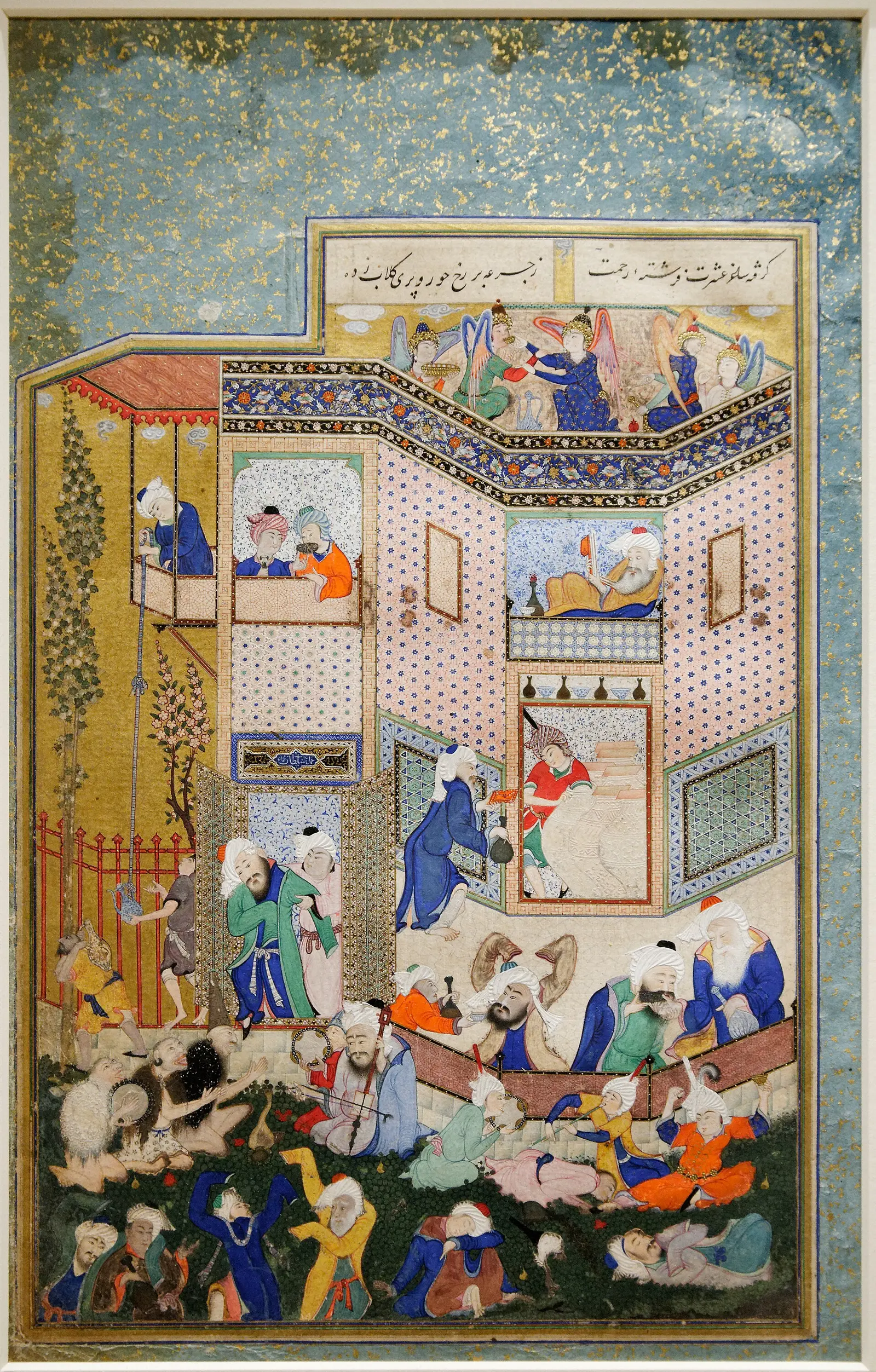
A Safavid painting by Sultan Muhammad from about 1530, made for a manuscript of Hafez's Divan in Tabriz, is titled 'Heavenly and Earthly Drunkenness.' It is jointly owned by Harvard Art Museums and the Metropolitan Museum of Art.9
Alex Rowell's 2018 English translation of about 120 of Abu Nuwas's wine poems keeps the single-rhyme scheme of the Arabic originals, which date to the ninth century.6
What it left behind
Hafez's tomb in Shiraz still draws visitors who touch the carved stone and recite his verses. Many Iranians open his book at random and take guidance from the line they find.4
NPR reports that conservative readers in Iran take Hafez's wine as a metaphor for the love of God, while others find political meaning in some poems.4
FitzGerald's Rubaiyat went through hundreds of editions, was translated into many languages and inspired Omar Khayyam clubs.8
Hafez's current mausoleum in Shiraz, the Hafezieh, was designed by André Godard in the late 1930s. A Hafez–Goethe monument in Weimar marks his influence on German literature.5
Questions people ask
Is the wine in Hafez's poetry literal or mystical?
Scholars disagree. Many read it as an image of divine love; others read it literally or as irony toward hypocrisy. Annemarie Schimmel held that it is neither purely mystical nor purely worldly.4,5,7
Did Omar Khayyam write the Rubaiyat?
Some of it. Many quatrains under his name were probably written by others. MacTutor says only about 120 can be attributed to him with certainty.2,3
Sources
- Poems of Wine and Revelry: The Khamriyyat of Abu Nuwas, Routledge (2005). Accessed 2026-11-18.
- Umar Khayyam, Stanford Encyclopedia of Philosophy (2023). Accessed 2026-11-18.
- Omar Khayyam (biography), MacTutor History of Mathematics, University of St Andrews (1999). Accessed 2026-11-18.
- In Iran, A Poet's 700-Year-Old Verses Still Set Hearts Aflame, NPR (2016). Accessed 2026-11-18.
- Hafez, Wikipedia. Accessed 2026-11-18.
- Vintage Humour: The Islamic Wine Poetry of Abu Nuwas, Hurst Publishers (2018). Accessed 2026-11-18.
- Jami on Divine Love and the Image of Wine (Studies in Mystical Literature 1/3, 1981), Muhyiddin Ibn Arabi Society (1981). Accessed 2026-11-18.
- Rubaiyat of Omar Khayyam, Wikipedia. Accessed 2026-11-18.
- Heavenly and Earthly Drunkenness, folio from a manuscript of Divan of Hafiz (1988.460.1), Harvard Art Museums. Accessed 2026-11-18.