The people
- Nahua peoples, including the Mexica: Among the Nahua, pulque (octli) had sacred meaning, so drinking it was strictly regulated and the general population could drink it only at community celebrations.1
- People of Teotihuacan: Teotihuacan, a city of perhaps 100,000 people in the Central Mexican highlands, stored pulque in amphorae sealed with pine resin, according to residue analysis of its pottery.2
- Mixtec peoples: The Postclassic Mixtecs knew the goddess of the maguey plant as 11 Serpent, and Mayahuel and the pulque gods appear in the Mixtec Codex Vindobonensis.3
The story
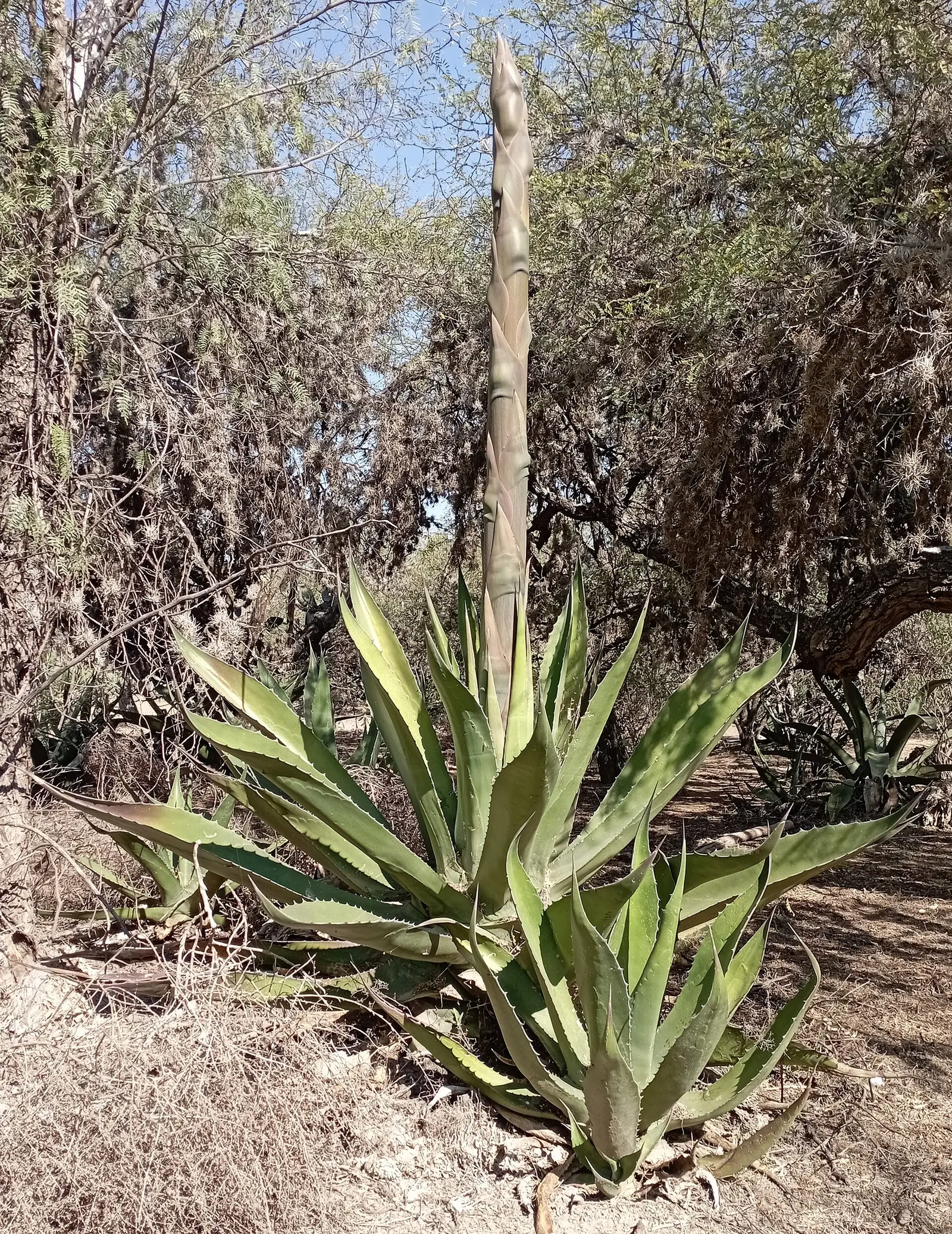
Pulque is a cloudy, whitish fermented drink made from aguamiel ('honey water'), the sap of several species of agave, or maguey. It has been made in Mexico since before European contact.4
A 2022 study dates pulque drinking back at least 2,300 years. Pulque can be made from the sap of 46 agave species and is produced today in 20 of Mexico's 32 states.1
Producers collect the sap by cutting out the flower bud of a mature plant, which leaves a basin that keeps refilling with sap. The sap ferments for several days, often with some older pulque added to speed it up.1,4
In central Mexico the maguey had its own goddess, Mayahuel. According to one Nahua myth retold by historians, Quetzalcoatl carried her to earth, and the first maguey grew from her buried remains. The Centzon Totochtin ('400 Rabbits'), the pulque gods, were her children.3
Mexica society limited who could drink pulque. Public drinking was a privilege of nobles and warriors, and penalties for drunkenness ran from head-shaving to death for repeat cases, according to World History Encyclopedia.1,3
An INAH archaeologist notes that, according to the Codex Chimalpopoca, four drinks of pulque was the proper amount, and a fifth meant drunkenness. Small pulque vessels at Zultépec-Tecoaque, Tlaxcala, turn up in groups of four.5
After the Spanish conquest, pulque lost its sacred status and became an everyday drink, especially for Indigenous and mestizo people. Colonial and church authorities pushed to regulate it, and New Spain began licensing and taxing pulque sales in 1580.1
In 1672 New Spain banned mobile pulque stands and allowed 36 fixed outlets, the first formal pulquerías. Mexico City had nearly 500 by 1854 and 1,691 by 1909.1
How we know
Researchers analyzed lipids from more than 300 potsherds from Teotihuacan dated to c. 200–550 CE. Fourteen held hopanoids from Zymomonas mobilis, the bacterium that ferments pulque. The authors call this the earliest direct chemical evidence of pulque production.2
Before that study, the case for pulque at Teotihuacan rested on murals of maguey plants and possible drinking scenes, on amphorae like later pulque vessels, and on stone scrapers thought to be used to extract sap.2
Codex Mendoza (c. 1541, or by 1553 at the latest) draws pulque as a bowl with froth bubbling over the rim, glossed 'vino' (wine) in Spanish.6
An octecómatl (pulque vessel) from Zultépec-Tecoaque, Tlaxcala, shows a maguey with its leaves being cut and refers to Mayahuel. INAH says it held 'blue pulque', which priests and sacrificial victims drank.5
Images of Mayahuel survive in art. The earliest is a Postclassic rock painting at Ixtapantongo that shows her inside a maguey, holding a cup in each hand. She also appears in the 16th-century Codex Magliabechiano.3
What it left behind
Pulquerías declined in the 20th century. After the Revolution, campaigns branded pulque backward, taxes rose, and beer was promoted as modern. In 1954 Mexico City stopped licensing new pulquerías. More than 1,500 operated in the early 1900s, but only 72 by 2012.1
A 2015 study of 25 Mexico City pulquerías found most of their pulque coming from Tlaxcala and Hidalgo, largely from Nanacamilpa. Their servers, called jicareros, mixed 69 flavors of curados with fruit, vegetables and seeds.1
Fresh pulque is drunk unaged within a few days, either plain or as pulque curado, flavored with fruit juice. Some pulque is pasteurized and bottled.4
INAH's site museum at Zultépec-Tecoaque, Tlaxcala, holds the octecómatl pulque vessel. It was lent to the Madrid exhibition 'La mitad del mundo. La mujer en el México indígena' (2025–2026).5
Questions people ask
What is pulque made from?
Pulque is fermented aguamiel, the sap of maguey (agave) plants. It is cloudy and white and has about 6 percent alcohol, according to Britannica. A 2022 study gives a range of 2–7 percent.1,4
Who was Mayahuel?
Mayahuel was the central Mexican goddess of the maguey plant and pulque. She is often shown emerging from a maguey, and the 400 pulque gods were her children.3,5
Where does the word pulque come from?
The 2022 study traces 'pulque' to a Spanish rendering of the Nahuatl poliuhqui, 'decomposed'. The Nahuatl name for the drink itself was octli.1
Can you still drink pulque in Mexico City?
Yes. Pulquerías are still the main places to drink it in the city, though far fewer remain than the 1,500 or more of the early 1900s.1
Sources
- Pulque and pulquerías of Mexico City: a traditional fermented beverage and spaces of biocultural conservation, Journal of Ethnic Foods 9, article 40 (2022). Accessed 2026-11-18.
- Pulque production from fermented agave sap as a dietary supplement in Prehispanic Mesoamerica, Proceedings of the National Academy of Sciences (PNAS) 111(39):14223–14228 (2014). Accessed 2026-11-18.
- Pulque, World History Encyclopedia (2016). Accessed 2026-11-18.
- Pulque, Encyclopaedia Britannica (2026). Accessed 2026-11-18.
- La vasija octecómatl, de Zultépec-Tecoaque, llega a su último mes de exposición en Madrid, España (Boletín 17), Instituto Nacional de Antropología e Historia (INAH) (2026). Accessed 2026-11-18.
- octli (Mdz71r), Visual Lexicon of Aztec Hieroglyphs (Wired Humanities Projects). Accessed 2026-11-18.