The people
- Italian immigrant home winemakers: Immigrant communities in eastern cities kept making wine for everyday meals and celebrations, buying California grapes that arrived by the railcar.1,2
- Cesare Mondavi: An Italian immigrant in Minnesota whose neighbors sent him to California to find grapes for home winemaking. He moved his family to Lodi and shipped grapes wholesale across the country.1
- Beaulieu Vineyard and the Concannon family: California producers that held government permits to make wine for sacramental and other allowed uses during Prohibition.1
The story
Congress passed the Eighteenth Amendment in December 1917 and it was ratified on January 16, 1919. It banned making, selling or transporting intoxicating liquors for drinking, starting one year after ratification.3
Prohibition began on January 17, 1920. The Volstead Act defined intoxicating liquor as anything with at least one-half of 1 percent alcohol, with exemptions for religious, medicinal and scientific uses.4
In 1919 California had about 700 bonded wineries. Because the law allowed wine for sacramental and medicinal use, some stayed open: Beaulieu Vineyard called itself 'The House of Altar Wines' and shipped wine in barrels marked 'FLOUR' to discourage theft.1
The law let heads of households make up to 200 gallons of wine a year at home. Grape prices soared, and California's vineyards grew from about 300,000 acres in 1920 to 577,000 by 1927.1
Growers planted thick-skinned red grapes such as Alicante Bouschet and Zinfandel that could survive the trip east. More than 26,000 railcars of grapes left California in 1920, and over 72,000 in 1927.1
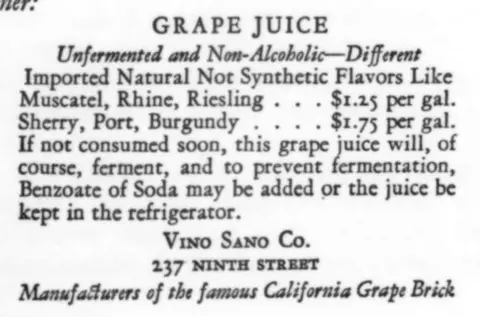
Vintners also sold 'wine bricks' of concentrated grape juice. The label told buyers how to dissolve the brick in a gallon of water, then 'warned' that leaving the jug for 21 days would turn it into wine.4,5
The boom did not last. By 1926 supply outran demand, and the price of a ton of California grapes fell from about $60 in 1926 to $17 in 1928.1
Other countries tried bans too. Finland's Prohibition Act took effect in June 1919 and ended in 1932 after about 70% voted for repeal; Norway banned spirits until 1927; Iceland banned all alcohol in 1915, allowed wine from 1921 and kept a ban on strong beer until March 1, 1989.6,7,8
How we know
The National Museum of American History holds a 1929 bottle of Concannon sherry, donated in 2014, whose label carries its bonded-winery permit details.1
Surviving Vino Sano grape-brick instructions told buyers to add benzoate of soda 'to prevent fermentation', a reminder that without it the juice would turn into wine.4
Railroad shipment counts and grape prices, from 26,000 railcars in 1920 to over 72,000 in 1927, show how large the home-winemaking market became.1
No reliable sales data exist for the dry years, so economists use cirrhosis death rates as a proxy. Economist Jeffrey Miron concludes that Prohibition had little lasting impact on the path of alcohol consumption.9
What it left behind
The Twenty-first Amendment, ratified on December 5, 1933, repealed the Eighteenth. By then the number of bonded wineries nationwide had fallen to 268, and equipment, skills and markets had decayed.1,3
California lost much of its winemaking know-how and had few vineyards of higher-quality grapes. From repeal until the 1960s, about two-thirds of its wine was fortified, such as port- and sherry-style wines.2
Some old vines survived. The Pedroncelli family of Sonoma's Dry Creek Valley grafted buds from old Zinfandel vines on their 1927 property, the 'Mother Clone', to replant their vineyards.1
The Nordic bans left state alcohol shops behind. Finland opened its first state-run Alko stores in April 1932, and Norway founded the Vinmonopolet wine monopoly in 1922, in years when Portugal, Spain and France pressed Norway to buy their wines and Norway needed their markets for its stockfish.6,10
The place today: United States.
Questions people ask
Was wine legal during US Prohibition?
Commercial wine was banned, but the law allowed wine for sacramental and medicinal use, and households could make up to 200 gallons a year at home.1,4
What were Prohibition wine bricks?
Blocks of concentrated grape juice sold to dissolve in water. Labels 'warned' that leaving the juice for 21 days would make it ferment into wine.5
When did Prohibition end?
The Twenty-first Amendment repealed national Prohibition when it was ratified on December 5, 1933.3
Sources
- Grape gluts and Mother Clones: Prohibition and American wine, Smithsonian National Museum of American History (2018). Accessed 2026-11-18.
- Wine in America (interview with Jim Lapsley), PBS American Experience (2017). Accessed 2026-11-18.
- The Constitution: Amendments 11-27, U.S. National Archives. Accessed 2026-11-18.
- Artifact Spotlight: Alternative liquor products from Prohibition, The Mob Museum (2023). Accessed 2026-11-18.
- During Prohibition, Vintners Sold "Wine Bricks" Rather Than Wine, Smithsonian Magazine (2015). Accessed 2026-11-18.
- When New Year's Eve Was Overshadowed by April 4, TIME (2015). Accessed 2026-11-18.
- Brennevinsforbudet, Store norske leksikon (2025). Accessed 2026-11-18.
- Iceland: 30 Years Of Legal Beer, The Reykjavík Grapevine (2019). Accessed 2026-11-18.
- Alcohol Prohibition, EH.Net Encyclopedia (Economic History Association) (2001). Accessed 2026-11-18.
- Produktutvalget 1922–1945, Vinmonopolet. Accessed 2026-11-18.