The people
- Jules-Émile Planchon: A botany and pharmacy professor at the University of Montpellier who, in summer 1868, found the root insects on living vines and identified them as the cause of the blight.1
- Charles V. Riley: An entomologist who served as Missouri's State Entomologist. He found that American grapes carried the same insect but that their roots resisted it, and he worked with Planchon on the grafting solution.2
- Thomas Volney Munson: A grape breeder in Denison, Texas, who shipped phylloxera-resistant rootstock he had developed to France, where it was grafted with European vines.3
- Hermann Jaeger: A grape breeder whose work, alongside Munson's, is credited with helping keep the European wine industry from total collapse.3
- J. O. Westwood: An Oxford University professor who in June 1863 identified the insect on a vine leaf sent from a greenhouse in Hammersmith, London, the first such find in Europe.4
The story
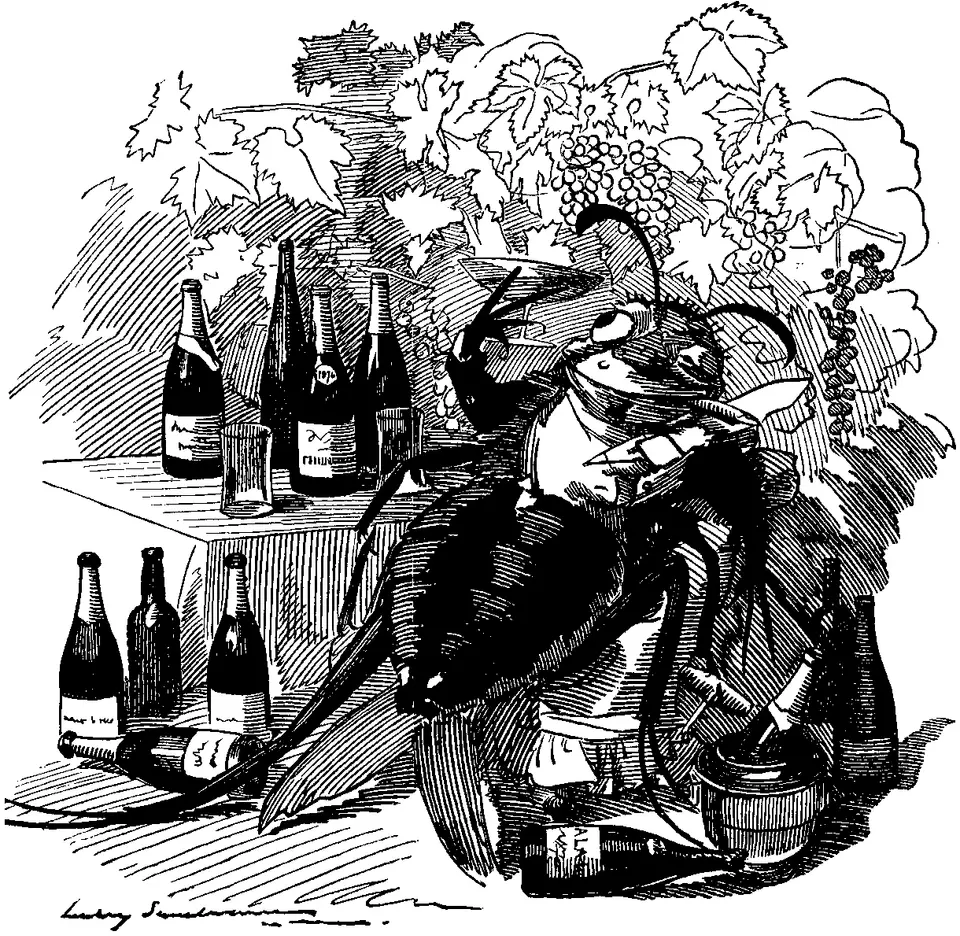
Grape phylloxera is a small greenish-yellow insect that sucks fluid from grapevines. It forms small galls on leaves and nodules on roots, which lead to the plant rotting.5
The insect came to Europe from the eastern United States in the mid-19th century. Within 25 years it had almost destroyed the grape and wine industries of France, Italy and Germany.5
In June 1863 an Oxford professor identified the insect on a leaf from a London greenhouse. Around the same time, an unknown disease began killing vineyards in France's Rhône valley.1,4
In summer 1868 Jules-Émile Planchon, part of a three-man commission, found tiny yellow root insects on living vines near the dead ones. He placed them in the genus Phylloxera and named them as the cause, against experts who first saw them as a symptom.1
The pest spread from the Languedoc across France and by the end of the 19th century had reached most of Europe and North Africa. Economists estimate it destroyed about 40% of French vineyards between 1863 and 1890.4,6
Growers tried many cures. They flooded vineyards, injected sulphur into the roots of each vine, and at Château Latour even spread ground, charred leather. Carbon disulphide treatment was dangerous and highly flammable.4,7
Charles V. Riley found that American vines carried the insect but that their roots resisted it. He and Planchon agreed that France should plant American vines as rootstock and graft French vines onto them; Planchon recommended this after visiting the United States in 1873.1,2
Texas breeder T. V. Munson shipped resistant rootstock to France. In 1888 the French government sent a delegation to Denison, Texas, to give him the Chevalier du Mérite Agricole honor.3
How we know
Planchon's key step was to examine living vines next to the dead ones. The cause could not be seen on the dead plants, but the roots of nearby live vines carried the insects.1
Riley's annual reports on the insects of Missouri (1868–76) and his 1874 article on phylloxera in Popular Science Monthly are held by the Linda Hall Library in Kansas City.2
A French government inquiry in 1869 confirmed that the aphid was the cause of the vine deaths.4
After a six-month search across the United States in 1887, Montpellier professor Pierre Viala described the chalk-tolerant species Vitis berlandieri, found in north Texas, in his 1889 report Une mission viticole en Amérique. Its hybrids SO4 and 110R are used in much of today's vineyards.8
A 2007 study by Banerjee, Duflo, Postel-Vinay and Watts used the pest's slow spread across French regions to measure its impact. Children born in hard-hit regions during the outbreak were about 1.8 millimeters shorter at age 20, with no detectable effect on infant mortality or life expectancy.6
What it left behind
Grafting European vines onto resistant American roots became the only reliable prevention, and almost all vines planted today are grown this way, even in many regions the pest barely touched.4,7
Some places escaped. Chile, walled in by the Andes and the Pacific, has stayed free; South Australia remains phylloxera-free through strict quarantine; and very sandy soils such as Hungary's Great Plain and Colares in Portugal proved immune. On Santorini the vines are ungrafted, many of them 60 to 250 years old.4,9,10,11
The pest is still a threat. In California in the 1980s about 50,000 acres of vines on the AxR1 rootstock were destroyed, and in Australia phylloxera is confined to parts of Victoria and New South Wales under zone controls.4,9
Montpellier put up a monument to Planchon in a city park in 1894. In Denison, Texas, the T. V. Munson Memorial Vineyard and the T. V. Munson Viticulture and Enology Center (opened 1988) honor Munson.1,3
The place today: France.
Questions people ask
What is phylloxera?
Grape phylloxera is a tiny insect from North America that feeds on grapevine roots and leaves. On European vines, the root damage leads the plant to rot and die.5
When did phylloxera arrive in Europe?
It came from the eastern United States in the mid-19th century. It was first identified in England in June 1863, and vines were dying in France's Rhône valley at about the same time.4,5
How was phylloxera stopped?
There is no cure. Growers graft European vine varieties onto the roots of American vine species, which resist the insect. Almost all vines planted today are grafted.4,7
Sources
- Scientist of the Day: Jules-Émile Planchon, Linda Hall Library (2023). Accessed 2026-11-18.
- Scientist of the Day: Charles V. Riley, Linda Hall Library (2017). Accessed 2026-11-18.
- Munson, Thomas Volney, Handbook of Texas Online, Texas State Historical Association (1995). Accessed 2026-11-18.
- Phylloxera: the parasite that changed wine forever, The Irish Times (2015). Accessed 2026-11-18.
- Grape phylloxera, Encyclopaedia Britannica (2026). Accessed 2026-11-18.
- Long Run Health Impacts of Income Shocks: Wine and Phylloxera in 19th Century France (NBER Working Paper 12895), National Bureau of Economic Research (2007). Accessed 2026-11-18.
- Ungrafted vines: in search of the Holy Grail, Falstaff (2023). Accessed 2026-11-18.
- 1887: a viticultural mission to America to save French vineyards, INRAE Agate digital library (2024). Accessed 2026-11-18.
- Grape Phylloxera, Vinehealth Australia. Accessed 2026-11-18.
- Greek Assyrtiko – Expert's choice, Decanter (2017). Accessed 2026-11-18.
- Discover the wine of the Assyrtiko grape variety, Decanter. Accessed 2026-11-18.