The people
- Louis Pasteur: A French chemist and microbiologist (1822–1895) who showed that microorganisms cause fermentation and wine spoilage and who gave his name to pasteurization.1
- Ulysse Gayon: A student of Pasteur and the first director of Bordeaux's Station agronomique et œnologique, founded in 1880.2
- Pierre Viala: A Montpellier professor of general viticulture who in 1887 searched the United States for phylloxera-resistant vines and found Vitis berlandieri in north Texas.3
- Jean Ribéreau-Gayon and Émile Peynaud: Bordeaux researchers who worked together from 1927 to 1977 and co-wrote the textbook Traité d'Oenologie. Ribéreau-Gayon was Ulysse Gayon's grandson.2,4
- Eduard von Lade: A wealthy citizen of Geisenheim who founded the town's institute for fruit growing and viticulture in 1872.5
The story
While at the University of Lille from 1854, Pasteur was asked to help a local distillery and began studying alcoholic fermentation. In 1857 he presented evidence that living organisms take part in all fermentations, each with its own specific organism.1
In 1863, at the request of Emperor Napoleon III, Pasteur studied spoiled wine and showed that microbes caused it. To stop them he heated wine to 50–60 °C (120–140 °F), the process now called pasteurization.1
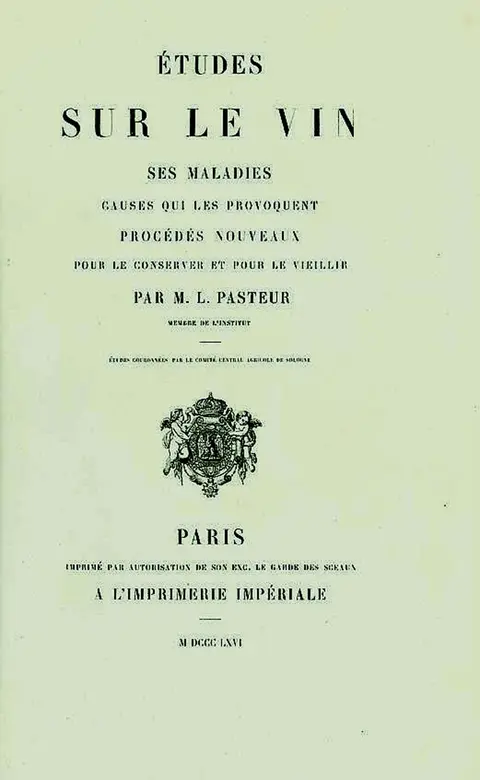
In 1866 he published Études sur le vin in Paris. Bibliographers note that heating wine to preserve it revived an earlier invention of Appert, but Pasteur tested it with rigorous experiments.6
Pasteur worked on fermentation in his private laboratory in Arbois, in the Jura wine country. Experiments at his vineyard in nearby Montigny-lès-Arsures helped him challenge the idea that microbes arise spontaneously.7
Bordeaux founded its Station agronomique et œnologique in 1880 to carry on Pasteur's work on wine, with his student Ulysse Gayon as first director. It joined the University of Bordeaux in 1916.2
In 1870 France's agricultural school at La Saulsaie moved to the La Gaillarde estate in Montpellier, where a vineyard was created in 1879. Montpellier became a leader in phylloxera research, and Gustave Foëx began a grapevine collection there in 1876.3,8,9
Geisenheim on the Rhine opened its Royal Prussian Institute of Pomology and Viticulture in 1872. On April 15, 1880, the California Legislature told the University of California to set up teaching and research in viticulture and enology.5,10
After Prohibition ended, UC's Department of Viticulture and Enology was set up at Davis in 1935, uniting vineyard and winery science in one department. UC Davis credits it with helping restart California's wine industry in the 1930s.10,11
How we know
Pasteur's 1866 book carries the full subject of his work: wine's diseases, their causes and new ways to preserve and age it. It was printed by the Imprimerie impériale in Paris.6
The library of Pasteur's house in Arbois keeps his annotated experiment logs, and holds archives listed on UNESCO's Memory of the World Register.7
Viala published a full description of the American vine species he found in 1889, in Une mission viticole en Amérique. INRAE has digitized it on its Agate library.3
At Bordeaux, Peynaud explained malolactic fermentation, which turns harsh malic acid into softer lactic acid; his ideas met resistance and gained ground in the 1960s.4
What it left behind
The professional title of œnologue was created in 1955, and Bordeaux's École Supérieure d'Œnologie trained its first enologists from 1956. Peynaud alone trained about 1,500 enologists.2,4
Montpellier's work led to the rootstocks used today. Hybrids of Vitis berlandieri such as SO4 and 110R are used in much of today's vineyards, and the grapevine collection moved in 1949 to Vassal, a sandy coastal site free of phylloxera where vines grow ungrafted.3,9
UC Davis lists a chain of later advances: climate-based variety advice in the 1940s, cellar sanitation that ended widespread vinegar spoilage in the 1950s, the Wine Aroma Wheel in the 1980s and DNA tests that revealed the parentage of Cabernet Sauvignon in the 1990s.11
Pasteur's house and laboratory at 83 rue de Courcelles in Arbois can be visited. Pasteurization itself is seldom used today for wines meant for aging, because it kills the organisms that help them age.1,7
Questions people ask
What did Louis Pasteur discover about wine?
He showed that living microorganisms drive fermentation and that specific microbes cause wine to spoil. In 1863 he found that gentle heating to 50–60 °C stopped spoilage.1
What is Études sur le vin?
Pasteur's 1866 book on wine's diseases, their causes and new ways to preserve and age wine, printed in Paris by the Imprimerie impériale.6
Is wine pasteurized today?
Rarely for wines meant to age. Britannica notes pasteurization kills organisms that contribute to aging, so it is mostly applied to other foods and drinks, especially milk.1
What are the oldest wine science schools?
Geisenheim in Germany dates to 1872, Bordeaux's oenology station to 1880, and the University of California's viticulture and enology mandate to 1880. Montpellier's agricultural school moved to La Gaillarde in 1870.2,5,8,10
Can you visit Pasteur's laboratory?
Yes. His house and private laboratory at 83 rue de Courcelles in Arbois, in France's Jura, are preserved and open to visitors.7
Sources
- Louis Pasteur, Encyclopaedia Britannica (2026). Accessed 2026-11-18.
- Université de Bordeaux – Diplôme national d'œnologue, Union des Œnologues de France. Accessed 2026-11-18.
- 1887: a viticultural mission to America to save French vineyards, INRAE Agate digital library (2024). Accessed 2026-11-18.
- Émile Peynaud, World of Fine Wine (2025). Accessed 2026-11-18.
- History, Hochschule Geisenheim University. Accessed 2026-11-18.
- Études sur le vin (bibliography entry), HistoryofMedicine.com (Jeremy Norman). Accessed 2026-11-18.
- Maison & Laboratoire de Louis Pasteur, Montagnes du Jura (regional tourism board). Accessed 2026-11-18.
- Historique d'une Grande Ecole, L'Institut Agro Montpellier. Accessed 2026-11-18.
- Historique (Vassal-Montpellier grapevine collection), INRAE Vassal-Montpellier Grapevine Biological Resources Center. Accessed 2026-11-18.
- History, UC Davis Department of Viticulture and Enology. Accessed 2026-11-18.
- Timeline, UC Davis Department of Viticulture and Enology. Accessed 2026-11-18.