The people
- Shulaveri-Shomu culture (Shulaveri-Shomutepe Culture): The two villages belong to the Shulaveri-Shomutepe (Shulaveri-Shomu) culture, an early farming culture of the South Caucasus dated to roughly 5900–5000 BCE that reached into western Azerbaijan and northern Armenia. The 2017 study proposed an earlier first phase reaching back into the seventh millennium BCE.1
The story
In November 2017 a team led by Patrick McGovern of the Penn Museum reported in PNAS that pottery from two Neolithic villages in Georgia, Gadachrili Gora and Shulaveris Gora, held chemical traces of grape wine.1,2
The villages lie about 2 km apart in Kvemo Kartli province, roughly 50 km south of Tbilisi, on a plateau above 1,000 m. Each covered about one hectare, with closely packed round mudbrick houses, pits and courtyards.1
The researchers dated the wine to about 6000–5800 BCE. That pushed the earliest known winemaking from the Eurasian grape back by 600 to 1,000 years.2,3
The earlier record holder was a jar from Hajji Firuz Tepe in Iran's Zagros Mountains, dated c. 5400–5000 BCE and held by the Penn Museum.2,3
The wine came from the Eurasian grape, Vitis vinifera. McGovern noted that the sites lie in an area where wild grape has grown since the end of the last Ice Age.2
Unlike the Hajji Firuz jar, the Georgian jars showed no tree resin or other additive. National Geographic reported that this early wine was likely a seasonal drink made without preservatives.1,4
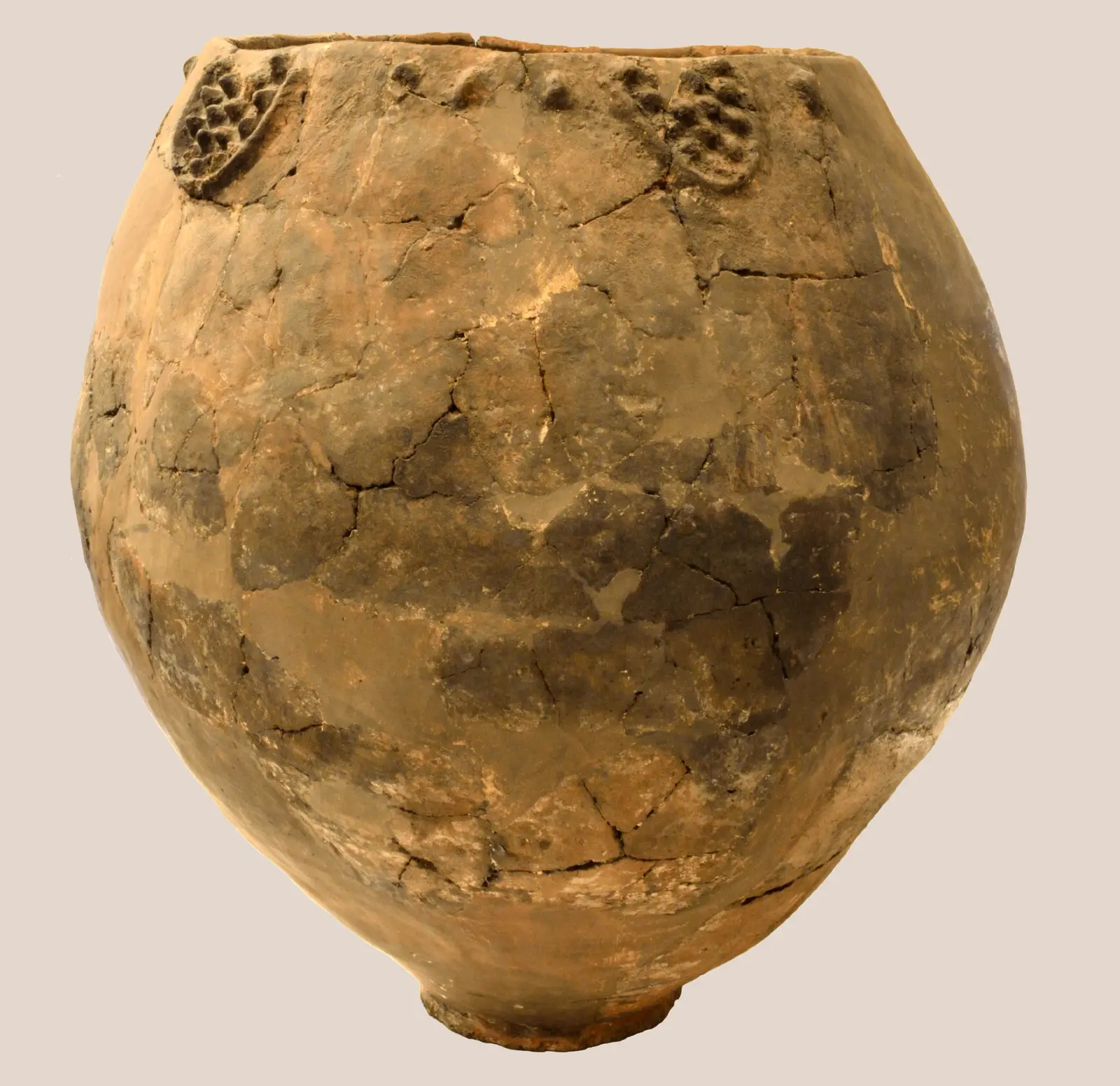
The jars are very large and among the earliest pottery in the Near East, likely used for fermenting, aging and serving. Clay blobs and strips around some rims may depict grape clusters.1,4
The digs were run by the Gadachrili Gora Regional Archaeological Project Expedition (GRAPE), a joint project of the University of Toronto and the Georgian National Museum. Georgia's National Wine Agency helped fund the work.2,4
How we know
Using liquid chromatography with tandem mass spectrometry (LC-MS/MS), the team found tartaric acid, the main chemical marker for grapes and wine in the Near East, plus malic, succinic and citric acids, in residues from eight jars: five from Gadachrili and three from Shulaveris.1,2
Soil from the same layers served as a control. The positive Gadachrili sherds held 3.4 to 12.4 times more tartaric acid than their soils, while eleven other samples fell below soil levels.1
Grape pollen was abundant in the Neolithic layers but absent from modern topsoil. One jar sherd also held grape starch, grapevine tissue and remains of fruit flies, which are drawn to sugar and alcohol.1
No Neolithic grape pips have turned up at these sites. National Geographic reported that the wine was probably made in the nearby hills and carried to the villages.1,4
Radiocarbon dating (accelerator mass spectrometry) of plant remains linked to the jars narrowed their use to about 6000–5800 BCE.3
What it left behind
A Neolithic jar from Khramis Didi-Gora, nearly 1 m tall and holding over 300 liters, is on display at the Georgian National Museum in Tbilisi. It comes from a related site, not from Gadachrili or Shulaveris.1,5
The Georgian sherds were shown at La Cité du Vin, the wine museum in Bordeaux, France, after the 2017 study.3
Georgia's qvevri winemaking, which ferments wine in large buried clay jars, was added to UNESCO's Representative List of the Intangible Cultural Heritage of Humanity in 2013. The 2017 study notes that buried jars are attested in Georgia only from the Iron Age, not the Neolithic.1,6
Georgian National Museum director David Lordkipanidze told National Geographic that large jars like the Neolithic ones are still used to make wine in Georgia today.4
The place today: Georgia.
Questions people ask
Where was the oldest grape wine found?
The earliest known evidence of wine from the Eurasian grape comes from Gadachrili Gora and Shulaveris Gora, two Neolithic villages about 50 km south of Tbilisi, Georgia, dated c. 6000–5800 BCE.1,2
How old is Georgian wine?
Residues in Neolithic jars show grape wine was made in Georgia about 8,000 years ago, around 6000–5800 BCE.1,4
Is Georgia's Neolithic wine the oldest fermented drink?
No. A mixed fermented drink from Jiahu, China, c. 7000 BCE, is older, but it combined rice, honey and fruit. The Georgian find is the earliest chemical evidence of grape wine in the Near East.1,4
Sources
- Early Neolithic wine of Georgia in the South Caucasus, Proceedings of the National Academy of Sciences (via PubMed Central) (2017). Accessed 2026-11-18.
- Archaeologists find earliest evidence of winemaking, University of Toronto (via EurekAlert!) (2017). Accessed 2026-11-18.
- Discovery finds winemaking is centuries older than previously believed, Penn Today, University of Pennsylvania (2017). Accessed 2026-11-18.
- Oldest Evidence of Winemaking Discovered at 8,000-Year-Old Village, National Geographic (2017). Accessed 2026-11-18.
- Neolithic Jar in Georgian National Museum (image), EurekAlert! (University of Toronto) (2017). Accessed 2026-11-18.
- Ancient Georgian traditional Qvevri wine-making method, UNESCO Intangible Cultural Heritage (2013). Accessed 2026-11-18.