The people
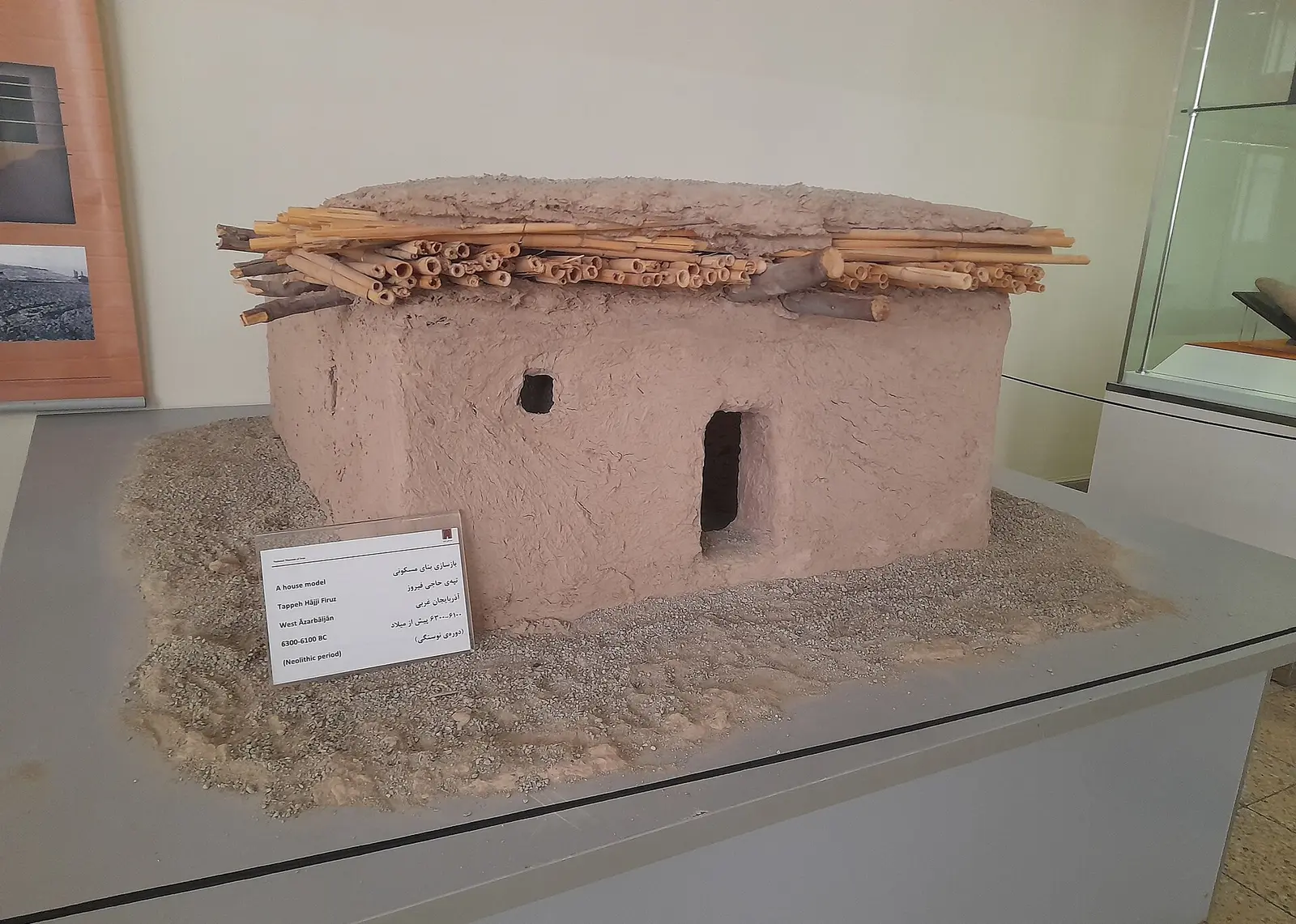
- Neolithic villagers of Hajji Firuz Tepe: The wine jars came from a mud-brick house with a kitchen, a large living room that may also have served as a bedroom, and two storage rooms. The Penn Museum's researchers suggest it may have housed an extended family.1
The story
Hajji Firuz Tepe is a Neolithic village mound in the northern Zagros Mountains of northwestern Iran, in West Azarbaijan Province.1,2
The Penn Museum dug the site as part of its Hasanlu Project between 1958 and 1968. Mary M. Voigt excavated the best-known wine jar in 1968.1,2
Six jars were set into the earthen floor along one wall of the house's kitchen, a room that also held a fireplace and many other pots.1,3
Each jar held about 9 liters (2.5 gallons). If all six held wine and were nearly full, the kitchen stored about 50 liters.1,3
In 1996 a team led by Patrick McGovern of the Penn Museum reported that the jars had held grape wine mixed with terebinth tree resin. At the time it pushed the earliest evidence of winemaking back by about 2,000 years.4,5
The resin was probably added to help preserve the wine and for its medicinal value. Terebinth and wild grapevine grew together in the region and fruited at about the same time, so the first mixing may have been accidental or deliberate.1,4
Clay stoppers about the size of the jar mouths were found nearby. The Penn researchers read them as a sign the jars were sealed to keep the wine from turning to vinegar.1
In 2017 older grape wine residues from Neolithic Georgia, c. 6000–5800 BCE, moved Hajji Firuz to second place. Unlike Hajji Firuz, the Georgian jars showed no tree resin.5,6
How we know
McGovern's team tested residues from two of the kitchen jars with infrared spectrometry, liquid chromatography and a wet chemical test. They found calcium tartrate in both jars and unaltered tartaric acid in one.1,4
Tartaric acid occurs in large amounts in nature only in grapes. At Hajji Firuz it survived mostly as its insoluble calcium salt, formed in the local limestone-rich soil.1,4
High-performance liquid chromatography and ultraviolet absorption matched another component to terebinth tree resin, so the residue was a mix of a grape product and resin, most likely wine.1
It is not known whether the wine came from wild or domesticated grapes. Pollen cores from nearby Lake Urmia show the site lies within the wild grapevine's ancient range.1
What it left behind
The reconstructed jar (object 69-12-15), 32 cm tall, is on display in the Middle East Galleries of the Penn Museum in Philadelphia.3,5
The Penn Museum describes it as one of the oldest known wine storage containers in the world.7
Resinated wine had a long afterlife. Pliny the Elder later praised terebinth resin for keeping wine from souring, and the Penn Museum calls modern Greek retsina the only surviving descendant of the practice.1
Questions people ask
Where can I see the Hajji Firuz wine jar?
The reconstructed jar is on display in the Middle East Galleries of the Penn Museum in Philadelphia.3,5
How old is the Hajji Firuz wine?
The Penn Museum dates the jar to about 5400–5000 BCE, in the Neolithic period.1,3
Is Hajji Firuz the oldest wine ever found?
Not anymore. It held the record from 1996 until 2017, when residues from Neolithic Georgia were dated to c. 6000–5800 BCE. The Penn Museum now calls its jar the second-oldest known.5,6
Why was there tree resin in the wine?
Researchers think terebinth resin was added to help keep the wine from spoiling and for its medicinal value. Clay stoppers found nearby suggest the jars were also sealed.1,4
Was the Hajji Firuz wine made from wild or domesticated grapes?
No one knows. The site lies within the wild grapevine's ancient range, so either is possible.1
Sources
- The Beginnings of Winemaking and Viniculture in the Ancient Near East and Egypt (Expedition Magazine 39:1), Penn Museum (1997). Accessed 2026-11-18.
- Hajji Firuz Tepe, Wikipedia. Accessed 2026-11-18.
- Wine Jar, object 69-12-15, Penn Museum Collections. Accessed 2026-11-18.
- World's Earliest Wine, Archaeology (Archaeological Institute of America), vol. 49 no. 5 (1996). Accessed 2026-11-18.
- Discovery finds winemaking is centuries older than previously believed, Penn Today, University of Pennsylvania (2017). Accessed 2026-11-18.
- Early Neolithic wine of Georgia in the South Caucasus, Proceedings of the National Academy of Sciences (via PubMed Central) (2017). Accessed 2026-11-18.
- Wine Jar, Penn Museum on Google Arts & Culture. Accessed 2026-11-18.