The people
- Late Chalcolithic people of Areni-1: The Copper Age people who used the cave are thought to be predecessors of the Kura-Araxes culture. They lived and kept household goods in the front gallery and used the rear gallery mainly for storage and ritual.1,2
The story
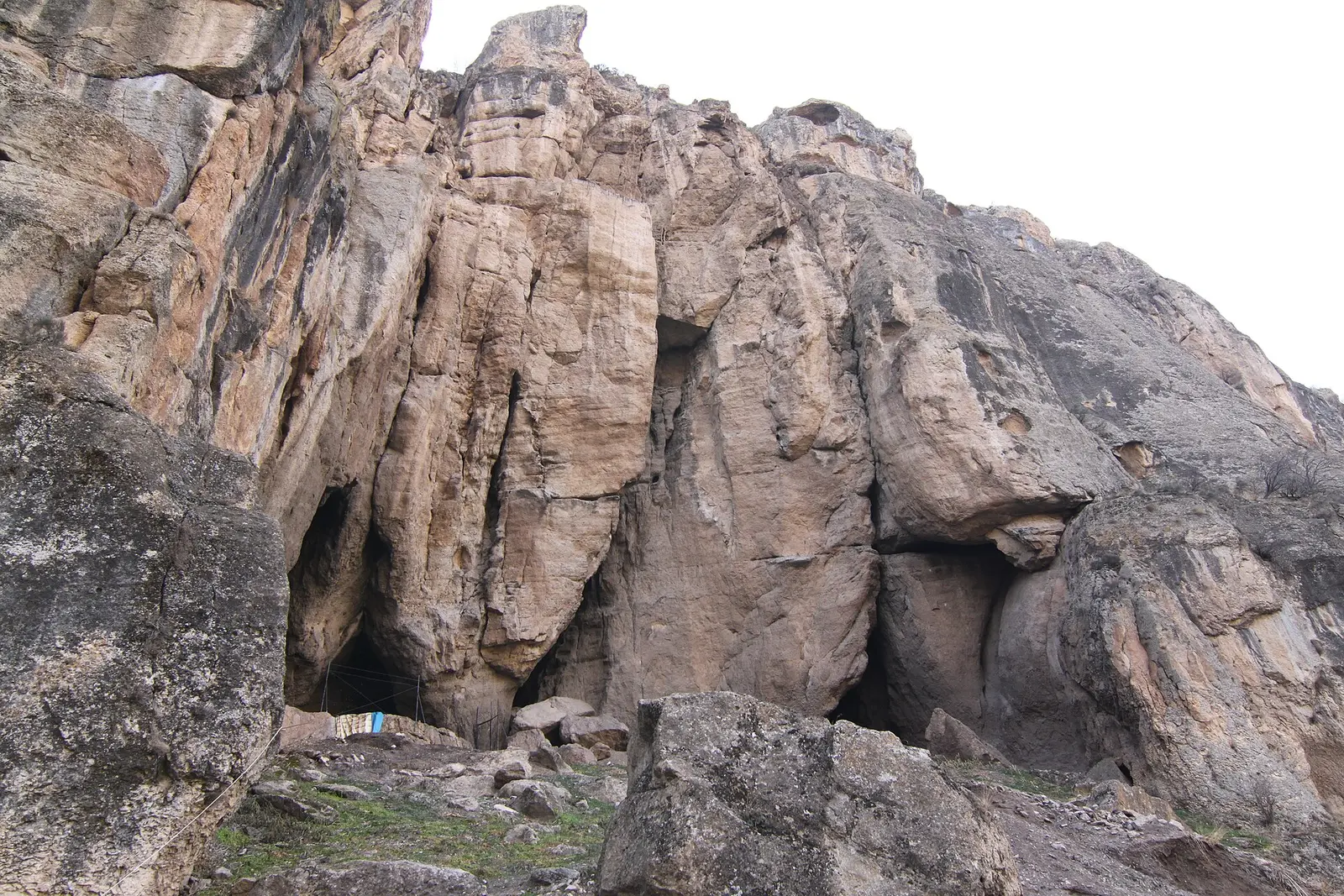
Areni-1 is a large karst cave near the village of Areni in Vayots Dzor province, southern Armenia, close to the border with Iran.1,2
A 2007 find of what looked like grape seeds led to a dig co-directed by Boris Gasparyan of Armenia's Institute of Archaeology and Ethnography, Gregory Areshian of UCLA and Ron Pinhasi, with Armenian, American and Irish archaeologists. The National Geographic Society supported the work.1,3
In January 2011 the team reported in the Journal of Archaeological Science a complete winemaking setup dated c. 4100–4000 BCE. UCLA called it the earliest known winery, about 1,000 years older than the next comparable find.1
Grapes were pressed in a shallow clay basin about 3 by 3.5 feet with a raised rim, which drained into a vat roughly 2 feet deep holding about 65 liters (14 to 15 gallons).1,4
The researchers argued that a vat this size points to wine, since unfermented juice would have soured quickly. World of Fine Wine notes that its size suggests the grapes were trodden by foot.1,4
The press and jars sat among dozens of graves, so the team thinks the wine had a ceremonial role, perhaps in rites for the dead. Everyday winemaking probably happened outside the cave, though no trace of it has been found.1,4
In the rear gallery, three clay pots each held the skull of a child or adolescent. A 2012 paper in Antiquity reads the cave as evidence of early social complexity, ritual burial and winemaking in the early fourth millennium BCE.2,5
Use of the cave ended when its roof collapsed. A layer of sheep dung then helped seal and preserve the remains.3,4
How we know
Radiocarbon dating at the University of California, Irvine and Oxford University placed the winemaking in 4100–4000 BCE, the Late Chalcolithic or Copper Age.1
The cave held grape seeds, pressed grape remains and dried vines. Paleobotanists identified the seeds as Vitis vinifera vinifera, the domesticated grape still used for wine.1,4
Chemists at UCLA's Pasarow Mass Spectrometry Laboratory found malvidin, the pigment that colors red wine, in sherds. Among local fruits only grapes and pomegranates contain it, and no pomegranate remains turned up.1,6
Drinking gear came from the same layers, including a cup made of animal horn and a complete clay drinking bowl.1
The cave's dry conditions preserved organic remains that rarely survive, such as reeds, rope, textiles, plant remains and wood.2,5
What it left behind
The same cave gave up the oldest known leather shoe: a one-piece right shoe 24.5 cm long, stuffed with grass and dated 3627–3377 cal BCE.1,2
Areni-1 is open to visitors and is often paired with modern wineries and the nearby Noravank Monastery. The village has held the annual Areni Wine Festival since 2009.3
Areni is also the name of a native red grape of the district. Vines more than a century old still fruit there, and the variety is now grown across Armenia's wine regions.4
Questions people ask
Where is the world's oldest winery?
The earliest known winemaking installation is in Areni-1 cave in Vayots Dzor, southern Armenia. Its press, vat and jars date to c. 4100–4000 BCE.1
Is Areni-1 the oldest wine ever found?
No. It is the oldest known winery, with a press and vat. Older wine residues come from jars in Neolithic Georgia (c. 6000–5800 BCE) and Hajji Firuz Tepe in Iran (c. 5400–5000 BCE).1,6
What grapes were used at Areni-1?
Seeds from the cave were identified as the domesticated wine grape, Vitis vinifera vinifera, and the red pigment malvidin points to red grapes.1,4
Why was wine made in a cave full of graves?
The excavators think the cave wine was for ceremonies, possibly rites for the dead buried nearby. Everyday wine was probably made elsewhere, though no site has been found.1,4
Can you visit Areni-1 cave?
Yes. The cave near Areni village is a visitor site, often combined with local wineries and Noravank Monastery.3
Sources
- Earliest known winery found in Armenian cave, UCLA (via Phys.org) (2011). Accessed 2026-11-18.
- First Direct Evidence of Chalcolithic Footwear from the Near Eastern Highlands, PLOS ONE (2010). Accessed 2026-11-18.
- Areni-1 winery, Wikipedia. Accessed 2026-11-18.
- Origin stories: Where wine began, World of Fine Wine (2023). Accessed 2026-11-18.
- The chalcolithic of the Near East and south-eastern Europe: discoveries and new perspectives from the cave complex Areni-1, Armenia, Antiquity 86(331), Cambridge University Press (2012). Accessed 2026-11-18.
- Early Neolithic wine of Georgia in the South Caucasus, Proceedings of the National Academy of Sciences (via PubMed Central) (2017). Accessed 2026-11-18.