The people
- Rulers of Dynasty 0 at Abydos: Tomb U-j at Abydos belonged to Scorpion I of Dynasty 0, one of the first rulers of Egypt, and is dated by radiocarbon to c. 3150 BCE.1
- Early Bronze Age winemakers of the southern Levant: The clay and painted style of the Abydos jars point to the southern Levant in Early Bronze I (c. 3300–3000 BCE), where the wine was most likely made.1,2
- New Kingdom royal households and vintners: Under the 18th Dynasty, wine was a prestige product of the royal family and the wealthy, and jar labels could name the vine grower.3,4
The story
The wild grapevine never grew in Egypt. The country's first wine came by trade from the Levant, and the Penn Museum team proposes that this demand later led to vines being planted in the Nile Delta.2
Around 3150 BCE, Scorpion I was buried at Abydos with some 700 jars of foreign type stacked in three chambers. Chemical tests on one jar showed wine flavored with tree resin and probably herbs.1
Some of the Abydos jars also held a single dried fig, while the jar that was analyzed contained several grape pips.1
By at least Dynasty 3 (about 2700 BCE), a royal winemaking industry worked in the Nile Delta. By the end of the Old Kingdom, a set of five wines was a standard provision for the afterlife.2
Wine stayed a drink of the elite. From the Predynastic period, jars of it were placed in tombs as offerings for the next life, and tomb paintings show how it was made.2,3
The tomb chapel of Nakht, a scribe at Thebes (c. 1410–1370 BCE), shows grape harvesting and wine production on the north side of its west wall.5,6
Tutankhamun (reigned c. 1333–24 BCE) was buried with wine jars labeled with product, year, source and even the vine grower's name. Royal vineyards of his reign were still named after the Aten, the god of his predecessor.4,7
Three opened wine jars stood east, west and south of Tutankhamun's sarcophagus. Their inscriptions and residues point to red wine, white wine and a fine fortified wine, which one scholar reads as chosen for symbolic meaning.8
How we know
At Abydos, residue in jar no. 156 tested positive for tartaric acid, a grape marker, and yeast DNA supported fermentation. Neutron activation analysis tied the clay to the southern Levant.1
Early Dynastic jar stoppers carried seal impressions naming the pharaoh, some with signs for vineyard and place names such as Buto and Memphis. The Penn team reads them as a primitive kind of wine label.2
New Kingdom labels called the product irp (wine) but never gave its color. A University of Barcelona team found syringic acid, a red-wine marker, in some Tutankhamun residues and not in others, and so identified both red and white wine.3,9
The same research found that shedeh, a drink named in Egyptian texts whose ingredients were unknown, was made from black grapes.3
Nine amphorae from Amenhotep III's palace at Malkata (c. 1390–1350 BCE) carried ink labels giving the regnal year, the Delta estate, the winemaker and notes on quality.1
What it left behind
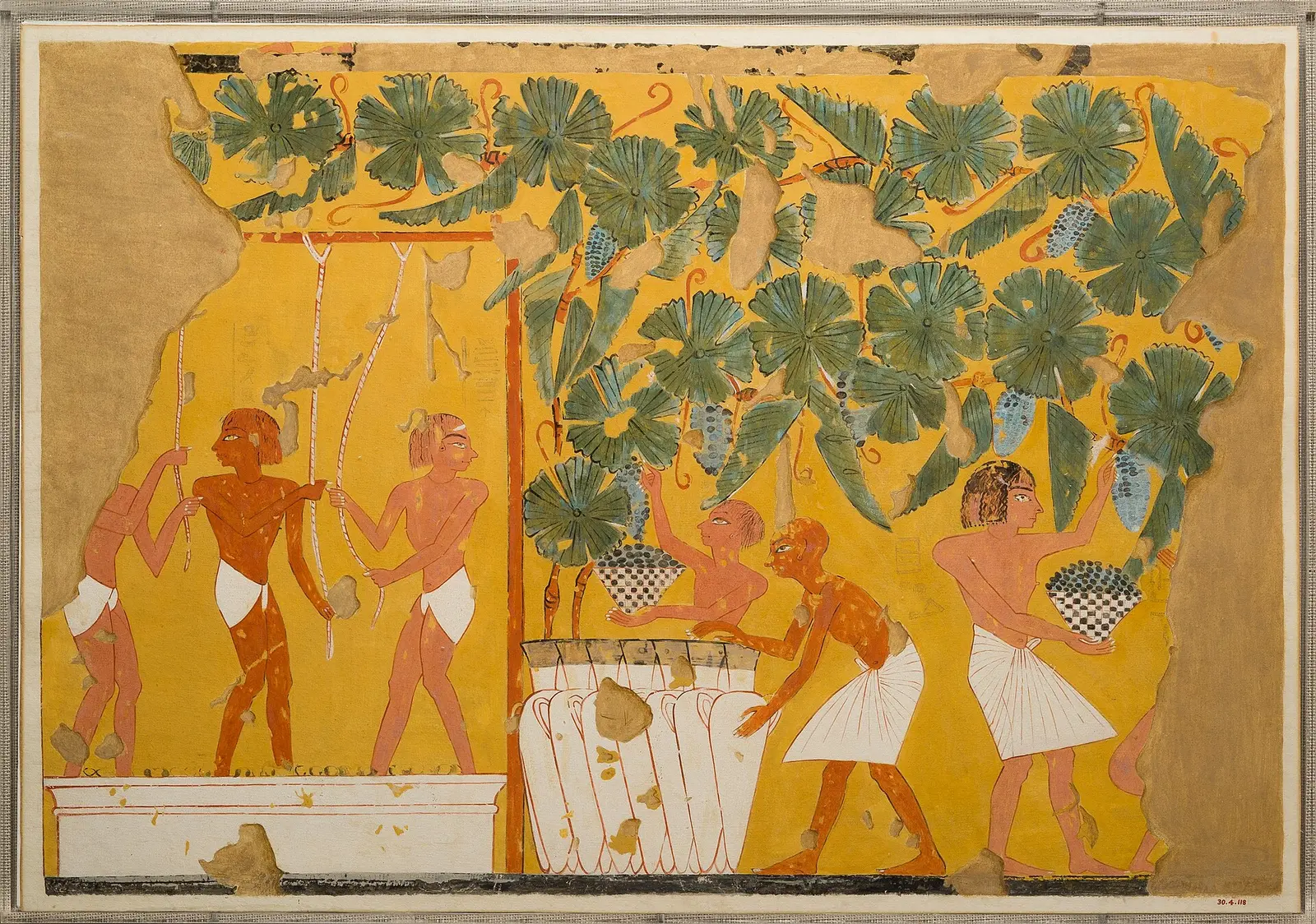
The Met in New York shows full-scale facsimiles of Theban tomb paintings in Gallery 135, including the west wall of Nakht's chapel and a winemaking scene from the tomb of Ipuy at Deir el-Medina (c. 1290–1224 BCE).6,10
Tutankhamun's treasures are housed at the Grand Egyptian Museum in Giza.7
Egyptian scribes left wine labels that still make sense today: the inked jars from Malkata (c. 1390–1350 BCE) read, as the researchers put it, like a modern wine label, giving year, estate and maker.1
Questions people ask
When did Egyptians first have wine?
By about 3150 BCE. The tomb of Scorpion I at Abydos held jars of resinated wine imported from the southern Levant.1
Did ancient Egyptians grow their own grapes?
Yes, later. Wild vines never grew in Egypt, but a royal winemaking industry worked in the Nile Delta by at least Dynasty 3, about 2700 BCE.2
What did Tutankhamun's wine labels say?
They recorded the product, the year, the source and even the vine grower's name. They never stated the wine's color.3,4
Did the Egyptians make white wine?
Yes. Residue analysis of jars from Tutankhamun's tomb gave the first chemical evidence of white wine in ancient Egypt, alongside red.9
Sources
- Ancient Egyptian herbal wines, Proceedings of the National Academy of Sciences (via PubMed Central) (2009). Accessed 2026-11-18.
- The Beginnings of Winemaking and Viniculture in the Ancient Near East and Egypt, Penn Museum, Expedition Magazine 39(1) (1997). Accessed 2026-11-18.
- El vi a l'antic Egipte (doctoral thesis), Universitat de Barcelona (2005). Accessed 2026-11-18.
- King Tut preferred red wine (UPI report), Phys.org / United Press International (2005). Accessed 2026-11-18.
- TT52 Tomb of Nakht (photographic archive), Museo Egizio, Turin. Accessed 2026-11-18.
- North Side of the West Wall of Nakht's Offering Chapel (facsimile, 15.5.19e), The Metropolitan Museum of Art. Accessed 2026-11-18.
- Tutankhamun, Encyclopaedia Britannica (2026). Accessed 2026-11-18.
- The meaning of wine in Egyptian tombs: the three amphorae from Tutankhamun's burial chamber, Antiquity 85(329) (2011). Accessed 2026-11-18.
- Jarring clues to Tut's white wine, Science News (2006). Accessed 2026-11-18.
- Winemaking, Tomb of Ipuy (facsimile, 30.4.118), The Metropolitan Museum of Art. Accessed 2026-11-18.