The people
- Canaanites of Kabri: In the Middle Bronze Age, Tel Kabri was the center of a major Canaanite polity, ruled from a palace dating mainly to the first half of the second millennium BCE.1,2
The story
Tel Kabri is a 34-hectare (75-acre) mound in Israel's Western Galilee, about 5 km east of Nahariya. In the Middle Bronze Age, c. 1900–1600 BCE, it was the seat of a Canaanite city.1,3
Its palace covered at least 6,000 square meters, the largest Middle Bronze Age palace excavated so far in Israel.1
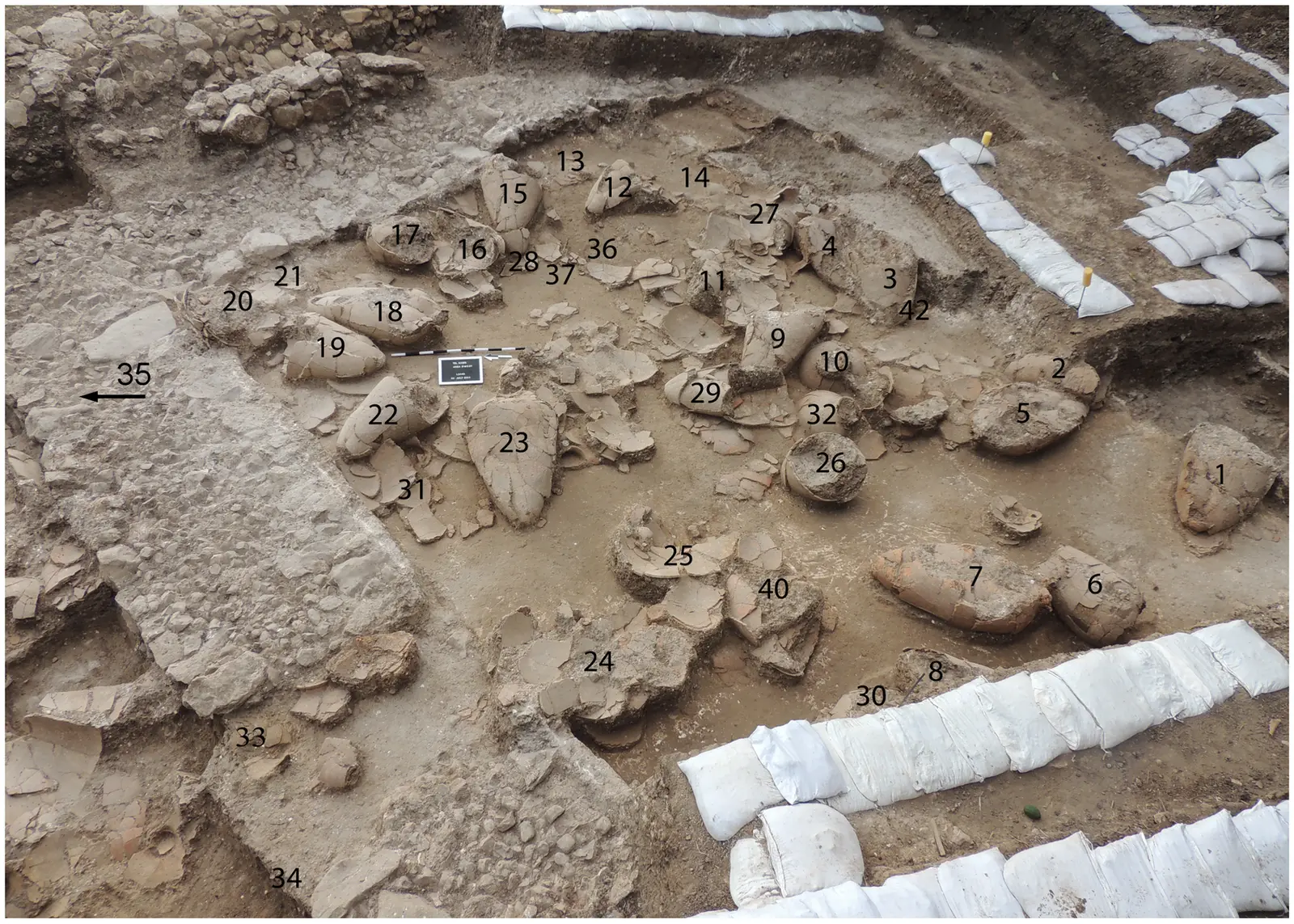
In July 2013 a six-week dig led by Eric Cline (George Washington University) and Assaf Yasur-Landau (University of Haifa), with Andrew Koh (Brandeis University) as associate director, uncovered a storeroom about 15 by 25 feet holding 40 large jars.3,4
Each jar held about 50 liters, for up to about 2,000 liters in all. The excavators compared that to roughly 3,000 bottles of wine.1,3
The cellar sat beside a banquet hall where the Kabri elite, and possibly foreign guests, ate goat meat and drank wine. Both rooms were destroyed in the same violent event, perhaps an earthquake, and buried under mudbrick and plaster.3,4
The team announced the find in November 2013 at the American Schools of Oriental Research meeting in Baltimore, and published the full analysis in PLOS ONE in August 2014.1,3,4
The authors think the wine was drunk inside the palace, perhaps as the private reserve of the ruler and his household, rather than traded. The cellar probably held a single vintage, refilled each year.1
Most jars seem to have held resinated red wine. Three jars lacked syringic acid and may have held white wine, though the authors say this is hard to confirm.1
How we know
Koh's team sampled 32 of the 40 jars, leaving eight untouched as controls. Residues from sherds near each jar's base were extracted with ethanol and analyzed by gas chromatography-mass spectrometry at Brandeis.1
Tartaric acid, the main marker for grape wine, was found in all 32 jars, and syringic acid in all but three. The mix was so uniform that Koh said the recipe was followed in every jar.1,3
Other compounds point to likely additives: honey, storax resin, terebinth resin and cedar oil, with mint, juniper, myrtle or cinnamon as more tentative candidates.1,3
Texts help read the recipe. Tablets from Mari, in Syria, from the 18th century BCE record wine shipped with oils of myrtle and juniper, and Egyptian medicinal recipes use similar ingredients.1,3
If the honey reading holds, it pushes back direct evidence of beekeeping in the southern Levant by at least seven centuries, compared with the hives found at Tel Rehov.1
What it left behind
Excavation of the palace's Wine Storage Complex continued through 2019. The results appear in Excavations at Tel Kabri III: The 2013 to 2019 Seasons (Brill, 2023).2
The same palace held Aegean-style wall paintings and a painted floor, first found in 1989. Kabri is the only site in Israel where frescoes of this kind have been found.5,6
Tel Kabri lies within Kibbutz Kabri, about 10 minutes from the old port city of Akko. Archaeology magazine advised visitors to arrange access with the excavation team in advance.6
Questions people ask
What is the oldest known palace wine cellar?
The cellar at Tel Kabri, Israel, dated to about 1700 BCE, is among the oldest and largest known in the Near East. Its 40 jars held up to about 2,000 liters.1,3
What was in Canaanite wine?
Residue tests at Tel Kabri point to grape wine likely mixed with honey, storax and terebinth resins and cedar oil, and possibly herbs such as mint, juniper or myrtle.1
Who drank the Tel Kabri wine?
The researchers think it served the palace itself, perhaps as the ruler's private reserve, poured at banquets in the hall next door.1,3
Was the Tel Kabri wine red or white?
Mostly red, the study suggests. Three jars lacked syringic acid and may have held white wine, but the authors say that is hard to confirm.1
Sources
- Characterizing a Middle Bronze Palatial Wine Cellar from Tel Kabri, Israel, PLOS ONE (2014). Accessed 2026-11-18.
- Excavations at Tel Kabri III: The 2013 to 2019 Seasons, University of Haifa research portal (Brill) (2023). Accessed 2026-11-18.
- Found: 1 of civilization's oldest wine cellars?, George Washington University (via EurekAlert!) (2013). Accessed 2026-11-18.
- One of Civilization's Oldest Wine Cellars?, Biblical Archaeology Society (2013). Accessed 2026-11-18.
- Minoan Frescoes at Tel Kabri, Biblical Archaeology Society (2013). Accessed 2026-11-18.
- Tel Kabri, Israel (Off the Grid), Archaeology (Archaeological Institute of America) (2011). Accessed 2026-11-18.