The people
- Athenians of the Classical city: Athenians had perfected the symposium, where dinner was followed by more drinks over cakes and small snacks, according to a British Museum curator.1
- Wine growers and potters of Thasos: The north Aegean island of Thasos was famous for its wine, which it exported in amphorae across the eastern Mediterranean and the Black Sea.2
- Worshippers of Dionysus: Dionysus, a god of fruitfulness, vegetation and wine, was already worshipped in the Mycenaean period: his name appears on a Linear B tablet of the 13th century BCE.3
The story
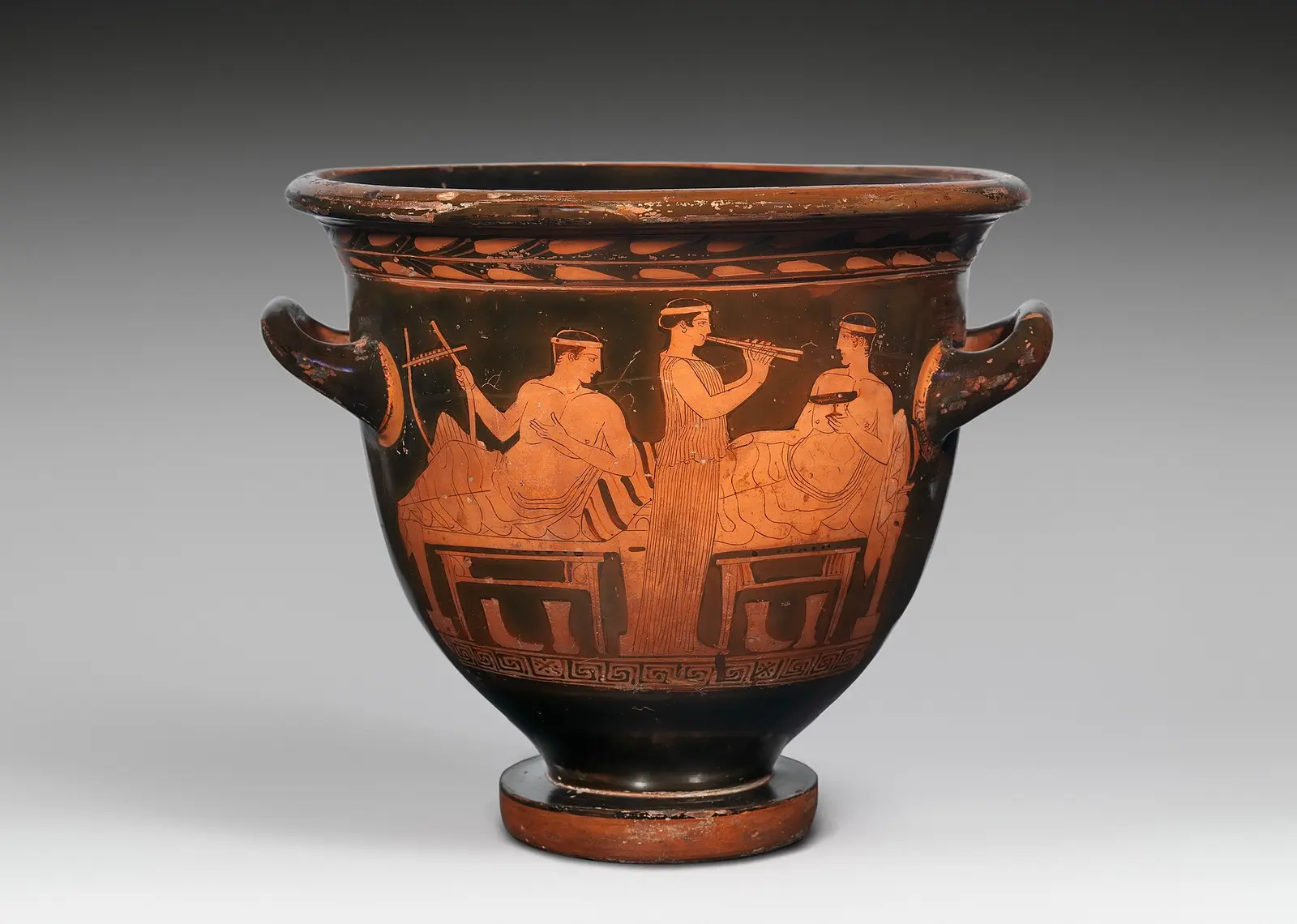
The symposium was a gathering of aristocratic men who reclined on couches, wearing garlands, in a room built for seven to fifteen couches with low tables.4
Wine was mixed with water in a large central bowl, the krater, to a strength set by the symposiarch, the master of ceremonies. Servers filled jugs from the krater and poured for each guest.4
Greeks drank their wine only mixed with water. Drinking it neat was thought as barbarian as drinking beer.1
Guests talked, often on set topics as in Plato's Symposium, recited poetry and played music. Professional musicians and dancers also performed.4
A well-run symposium passed on traditional values, while also giving guests a break from everyday restraint inside a carefully regulated setting.4
Everyday Athenian food included bread, cheese, lentil soup and small fried fish, and Athenian cheesecake was highly regarded. Prized imported wines came from Mende, Magnesia, Thasos and Chios.1
Dionysus was a god of wine whose festivals in Athens, the Lenaea and the Great Dionysia, included performances of tragedy and comedy.3
Thasos stamped its amphorae under a state system from the beginning of the 4th century BCE, the earliest such system in the Greek world. Athens was the only large market for Thasian wine south of the island.2
How we know
By the late 6th century BCE, there was a set range of symposium vessels: wine coolers, jugs, drinking cups and mixing bowls, many painted with drinking parties or with Dionysus and his followers.4
Many symposium rooms have been found in Greek houses. The Met calls the painted Tomb of the Diver at Paestum perhaps the best picture of one.4
Each Thasian amphora stamp names an official who changed every year, so stamps can be dated very closely. The system lasted more than two and a half centuries and produced more than 4,000 stamp types.2
More than 12,000 stamped Thasian amphora handles found outside the island document its wine trade. Why amphorae were stamped is still debated: taxes, quality, standards or materials have all been suggested.2
In Greek art, Dionysus is recognized by an ivy wreath, the thyrsus staff and the kantharos, a large two-handled cup.3
What it left behind
The American School of Classical Studies has excavated the Athenian Agora since 1931. The restored Stoa of Attalos houses the finds, and the site is a public archaeological park.5
The Agora holds a research collection of transport amphorae and one of the largest excavated collections of stamped Thasian handles, built up under the archaeologist Virginia Grace, who worked there from 1931 to 1994.2,6
The Met in New York illustrates the symposium with vessels from its collection, including a column-krater attributed to Lydos (c. 550 BCE) and a kylix attributed to the Amasis Painter (c. 540 BCE).4
The place today: Greece.
Questions people ask
What was a Greek symposium?
A gathering of men that followed dinner. Guests reclined on couches, shared wine mixed with water, talked, recited poetry and listened to music.1,4
Why did Greeks mix wine with water?
It was the norm. Wine was mixed in a central krater to a strength set by the master of ceremonies, and drinking it neat was considered barbarian.1,4
What is a krater?
A large bowl for mixing wine and water. It stood at the center of the symposium, and servers filled jugs from it for the guests.1,4
What do Greek amphora stamps tell us?
On Thasian jars, each stamp names a yearly official, so a handle can be dated closely. Thousands of stamps map where Thasian wine was traded.2
Sources
- Historical city travel guide: Athens, 5th century BC, British Museum (2020). Accessed 2026-11-18.
- Amphora Stamps from Thasos: An Interview with Chavdar Tzochev, American School of Classical Studies at Athens (2016). Accessed 2026-11-18.
- Dionysus, Encyclopaedia Britannica. Accessed 2026-11-18.
- The Symposium in Ancient Greece (Heilbrunn Timeline of Art History), The Metropolitan Museum of Art (2002). Accessed 2026-11-18.
- Athenian Agora Excavations, American School of Classical Studies at Athens. Accessed 2026-11-18.
- Amphoras and Amphora Stamps (Collections at the Agora), American School of Classical Studies at Athens. Accessed 2026-11-18.