The people
- Quechua- and Aymara-speaking peoples: 'Chicha' is a Spanish word. The older names for maize chicha are a'qa in Quechua and k'usa in Aymara.1
- Inca (Inka): In the Inca empire, the relationship between rulers and subjects was largely carried out through gifts of food and drink, and the state used a distinctive set of pottery at its feasts.2
- Aqllakuna ('chosen women'): The aqllakuna (also written acllas) grew, prepared and served food and drink, including maize chicha, for the Inca elite.1,3
- Wari: The Wari empire ruled much of Peru between about 600 and 1000 CE, before the Inca. It built a large brewery at its colony on Cerro Baúl in southern Peru.4
The story
'Chicha' is a Spanish word for many Andean drinks fermented from grain, fruit or tubers. The most widespread and traditionally important kind is chicha de jora, made from yellow or white maize.1
Chicha is made from more than maize. Some cooks in Trujillo and Cuzco add fruit, quinoa, cinnamon or cloves, and in the forests of Ecuador and Peru manioc takes the place of maize. The Wari also made chicha de molle from the small seeds of the Peruvian pepper tree (Schinus molle).1,4
Some archaeologists trace chicha back to the Chavín culture, around 900 BCE. Chicha production is documented at Wari and Inca breweries, and the Tiwanaku culture left many chicha cups (qeros).1
Under the Inca, commoners came to provincial capitals such as Huánuco Pampa to work for the state, on projects such as construction. In return the state held large festivals with gifts of beer, meat and maize, and feasts handed out chicha for shared labor such as building roads and canals.1,5
Chicha drinking followed rank. Invitations to drink went from superior to inferior and created obligations, and paired qeros used in toasts marked treaties.1
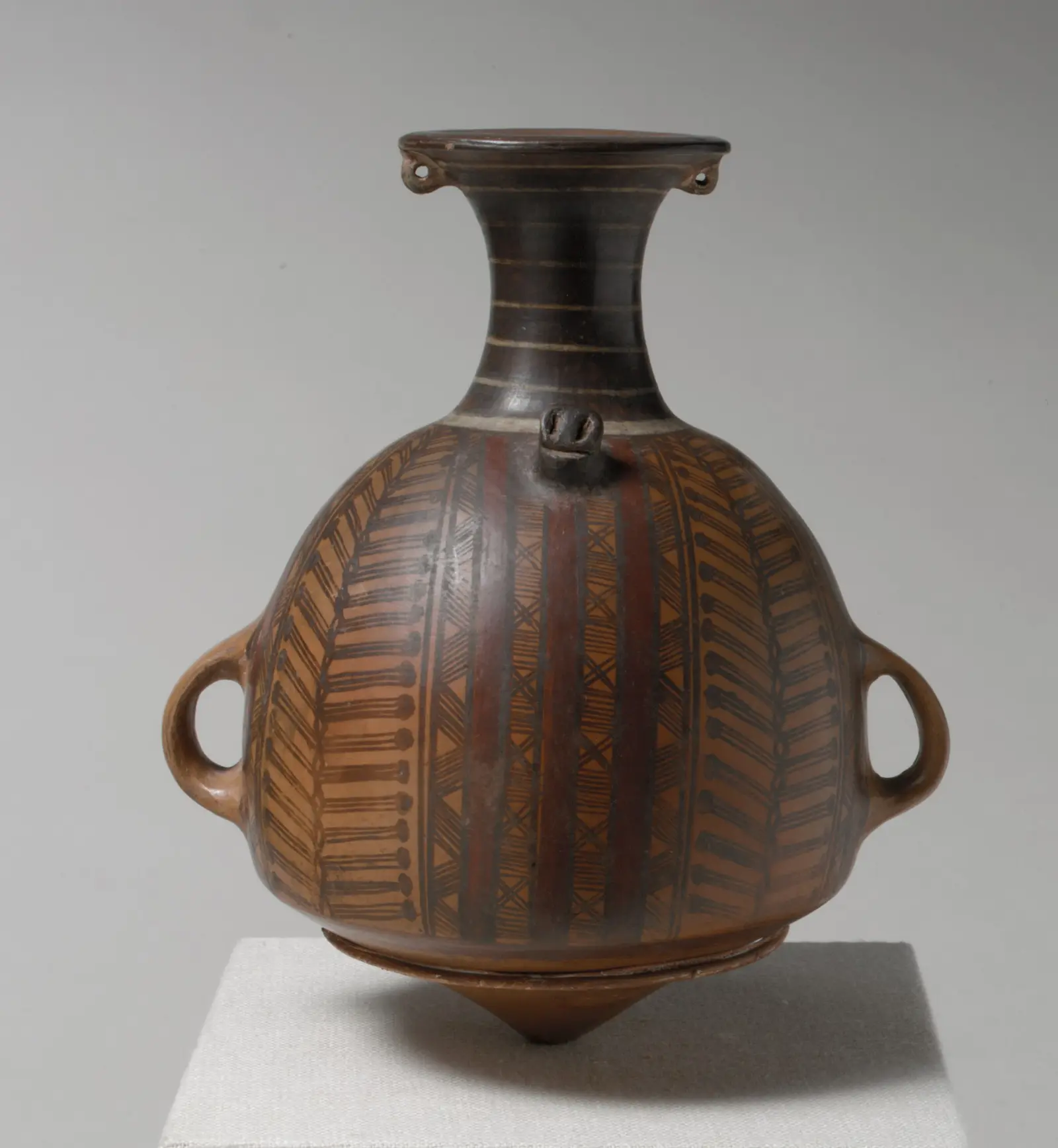
Archaeologist Tamara Bray argues that the Inca made a distinctive state pottery set to mark class difference at state feasts. The tall-necked jar (aríbalo, or urpu in Quechua) mattered most in the provinces, and her study highlights women's part in building Inca state power.2,6
Under Spanish rule, an official in 1566 banned giving chicha and other alcohol to Indigenous people in northern Peru. That broke the cycle of duties between rulers and subjects. Ritual drinking was repressed, and everyday brewing moved into homes and small chicherías.1
In the late 19th and early 20th centuries, racist campaigns tied chicha to dirt, crime and laziness. At the same time, the Indigenismo movement held it up as a symbol of Andean civilization.1
How we know
On Cerro Baúl in southern Peru, archaeologists excavated a Wari brewery with 12 fermentation vats of up to 150 liters each. That gives about 1,800 liters per batch, one of the largest pre-Inca breweries known in the Americas.4
Grinding stones for sprouted maize and thick ash layers full of molle seeds show that the Cerro Baúl brewery made chicha de jora, chicha de molle or a mix of both. Shawl pins (tupu), which marked elite women, were found there in numbers, which suggests elite women took a leading part in brewing.4
When the Wari left Cerro Baúl around 1000 CE, they brewed a final batch, feasted, smashed drinking cups and burned the brewery, in what the excavators read as a planned closing ceremony.4
At Saqsaywaman, above Cuzco, bioarchaeologist Bethany Turner studied 15th–16th-century skeletons, probably of aqllakuna. Their bones and teeth suggest they were likely not drinking the chicha they made, but their teeth decayed from chewing maize during brewing.3
What it left behind
Chicha is still made in the Andes, mainly in city outskirts and small towns. A red flag over a door signals that a chichería has chicha for sale.1
Chicha still pays for shared work in rural Peru, such as raising a house. In one account in the Smithsonian's American Indian magazine, a brewer pours the day's first chicha into a qero and spills some on the floor as an offering to Pachamama, the Andean earth deity.1
The Metropolitan Museum of Art shows Inca urpus (1400–1535 CE) in Gallery 361. Large ones were used to make, store and carry chicha, and their pointed bases could be set into the ground.6
Huánuco Pampa, an Inca provincial capital in the Peruvian Andes, was abandoned after the Spanish takeover in the 1530s. Its storehouses still hold broken pottery that once held food.5
Questions people ask
What is chicha made from?
Most traditional chicha, chicha de jora, is fermented maize. Other kinds use molle (Peruvian pepper tree) seeds, quinoa, fruit, or manioc in the Amazon lowlands.1,4
Sources
- The Persistence of Chicha, American Indian magazine, Smithsonian's National Museum of the American Indian (Vol. 19 No. 2) (2018). Accessed 2026-11-18.
- Inka Pottery as Culinary Equipment: Food, Feasting, and Gender in Imperial State Design, Latin American Antiquity 14(1):3–28 (2003). Accessed 2026-11-18.
- Chosen Women and Inka Statecraft: Bioarchaeology, Gender, and Foodways at Saqsaywaman, University of Alabama Press (description via MIT Press Bookstore) (2026). Accessed 2026-11-18.
- Burning down the brewery: Establishing and evacuating an ancient imperial colony at Cerro Baúl, Peru, Proceedings of the National Academy of Sciences (PNAS) 102(48):17264–17271 (2005). Accessed 2026-11-18.
- Huánuco Pampa (OLogy card 216), American Museum of Natural History. Accessed 2026-11-18.
- Urpu (jar), Inca, 1400–1535 CE (1978.412.68), The Metropolitan Museum of Art. Accessed 2026-11-18.