The people
- Phoenicians of the Levantine coast: Phoenicians, along with Canaanites before them and Greeks, were the main seafaring carriers of winemaking across the Mediterranean, according to a 2013 PNAS study.1
- Carthaginians (Punic civilization): Carthage was founded by Phoenicians from Tyre on the Gulf of Tunis in the 9th century BCE and grew into a trading empire covering much of the Mediterranean.2
- Mago of Carthage: Mago was a Carthaginian writer on agriculture whom the Roman author Columella called the father of husbandry.2,3
The story
Sidon, a Phoenician city on the coast of present-day Lebanon, lay on eastern Mediterranean sea routes, and Phoenician wine-drinking traditions spread to Europe and North Africa.4
Around 750 BCE, two Phoenician ships carrying fine wine sank in a storm off Ashkelon, Israel, probably bound for Egypt or Carthage. They lie upright about 400 meters down.5
The two wrecks suggest that ancient sailors took direct routes to their destinations, even when that meant sailing beyond sight of land.5
At Tell el-Burak, a farming settlement likely founded to supply Sidon grew grapes on a large scale and made wine for several centuries. Wine also had religious uses for the Phoenicians.4
Phoenician settlers brought the first cultivated vines to the Iberian Peninsula about 3,000 years ago. Researchers had long thought Iberian winemaking began with the Roman conquest.6
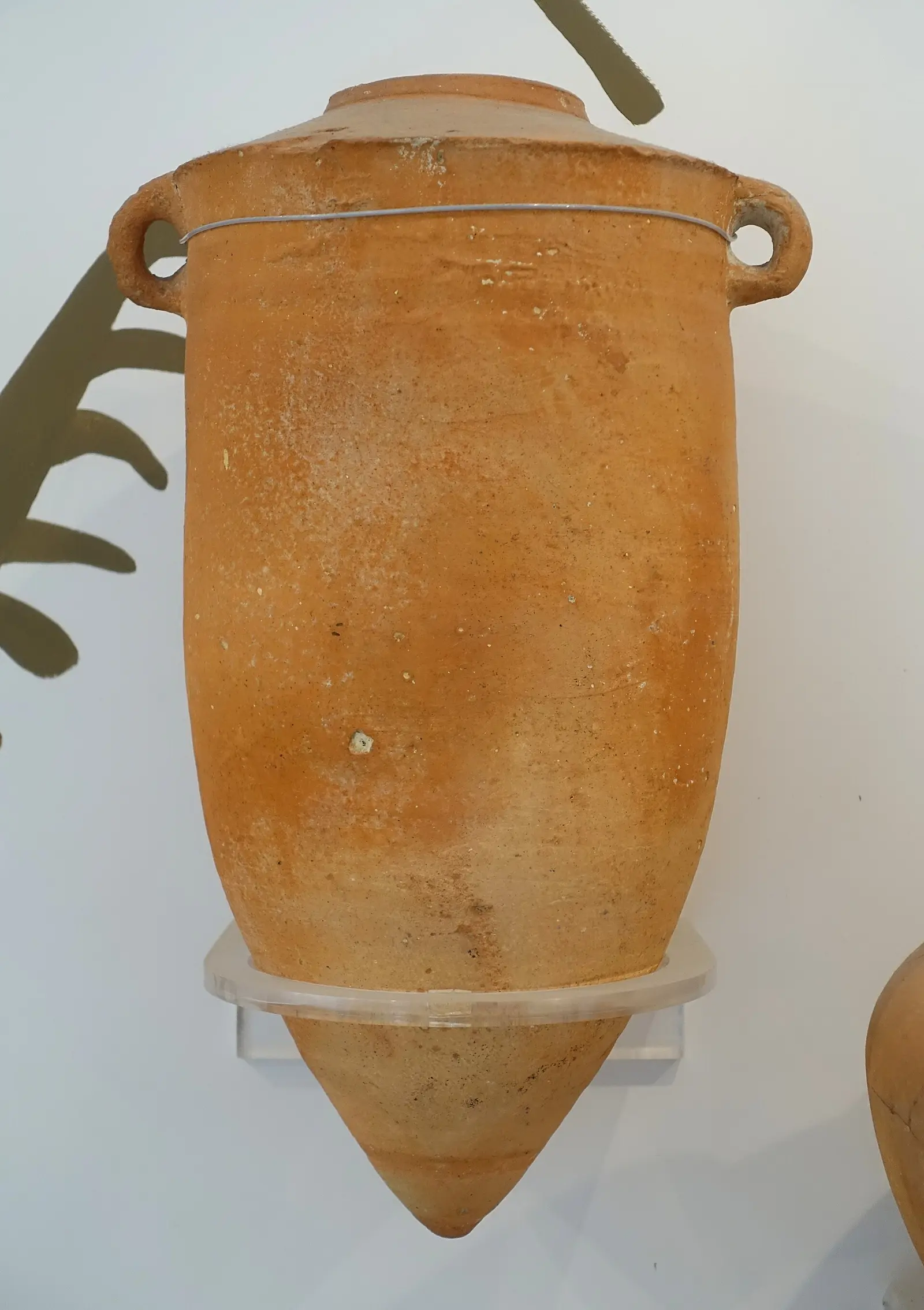
The Phoenician amphora served as the model for the Etruscan wine amphora, after Etruscans came into contact with Phoenicians by at least 800 BCE.1
Mago of Carthage wrote a treatise on farming in 28 books. Columella says it was translated into Latin by order of the Roman Senate.3
Pliny the Elder wrote that after Carthage was captured, the Senate gave the city's libraries to African kings but ordered Mago's books alone put into Latin, by men who knew the Carthaginian language.7
How we know
The US Navy research submarine NR-1 found the Ashkelon wrecks in 1997. A 1999 survey with remotely operated vehicles dated them to the 8th century BCE, the earliest known shipwrecks found in the deep sea.5
Tell el-Burak has the first Iron Age wine press found in present-day Lebanon, dated to the 7th century BCE. Its builders lined it with a hard, water-resistant plaster of lime and crushed pottery.4,8
Large numbers of amphorae at Tell el-Burak indicate that its wine was traded, not only drunk at home.4
Ancient DNA from 28 grape seeds from sites in Iberia and Sardinia links the first cultivated vines in Iberia to eastern Mediterranean grapes. These vines crossed early with local wild grapevines.6
What it left behind
The Archaeological Site of Carthage, near Tunis, is a UNESCO World Heritage Site. Visitors can see the Byrsa hill, the Punic ports and the tophet, among Punic and Roman remains.2
UNESCO's description of Carthage names the agronomist Magon among the city's famous figures, alongside Hannibal and the navigator Hanno.2
Mago's work survives only through later writers. Columella still quotes his advice that a man who buys a farm should sell his town house and live on the land.3
Questions people ask
Did the Phoenicians spread wine around the Mediterranean?
Yes. Scholars count Phoenicians, with Canaanites and Greeks, among the main seafaring carriers of winemaking, and they brought the first cultivated vines to Iberia.1,6
What were the Phoenician shipwrecks off Ashkelon carrying?
The two Phoenician ships, lost off Ashkelon in the 8th century BCE, carried cargoes of fine wine, probably bound for Egypt or Carthage.5
Who was Mago of Carthage?
A Carthaginian who wrote a multi-book farming treatise. Rome ordered it translated into Latin, and Columella called him the father of husbandry.3,7
Is there a Phoenician wine press?
Yes. Tell el-Burak, near Sidon in Lebanon, has a plastered wine press from the 7th century BCE, the first of the Iron Age found in Lebanon.4
Sources
- Beginning of viniculture in France, Proceedings of the National Academy of Sciences (via PubMed Central) (2013). Accessed 2026-11-18.
- Archaeological Site of Carthage, UNESCO World Heritage Centre. Accessed 2026-11-18.
- De Re Rustica, Book I (Loeb Classical Library, 1941), LacusCurtius, University of Chicago (1941). Accessed 2026-11-18.
- Iron Age wine press yields clues to Phoenician building techniques, University of Tübingen (2020). Accessed 2026-11-18.
- Iron Age Shipwrecks in Deep Water off Ashkelon, Israel, American Journal of Archaeology 106(2) (via JSTOR) (2002). Accessed 2026-11-18.
- Phoenicians Brought First Cultivated Grapevines to Iberia, Archaeology Magazine (Archaeological Institute of America) (2026). Accessed 2026-11-18.
- The Natural History, Book XVIII, Chapter 5: Illustrious men who have written upon agriculture (trans. John Bostock and H. T. Riley), Perseus Digital Library, Tufts University (1855). Accessed 2026-11-18.
- Phoenician lime for Phoenician wine: Iron Age plaster from a wine press at Tell el-Burak, Lebanon, Antiquity (via American University of Beirut ScholarWorks) (2020). Accessed 2026-11-18.