The people
- Etruscans: The Etruscans were an ancient Italic culture of central Italy, between the Arno and Tiber rivers, who flourished until they were absorbed into Roman culture at the end of the 2nd century BCE.1
- Gauls (Celts) of the Mediterranean coast: The people of southern France at the time, probably Celts or Gauls in McGovern's words, took an interest in imported wine and went on to make their own.2,3
- Phocaean Greeks of Massalia: Phocaean Greeks founded Massalia (Marseille) about 600 BCE. From the second half of the 6th century BCE it made its own wine amphorae, possibly to compete with Etruscan wine.3
The story
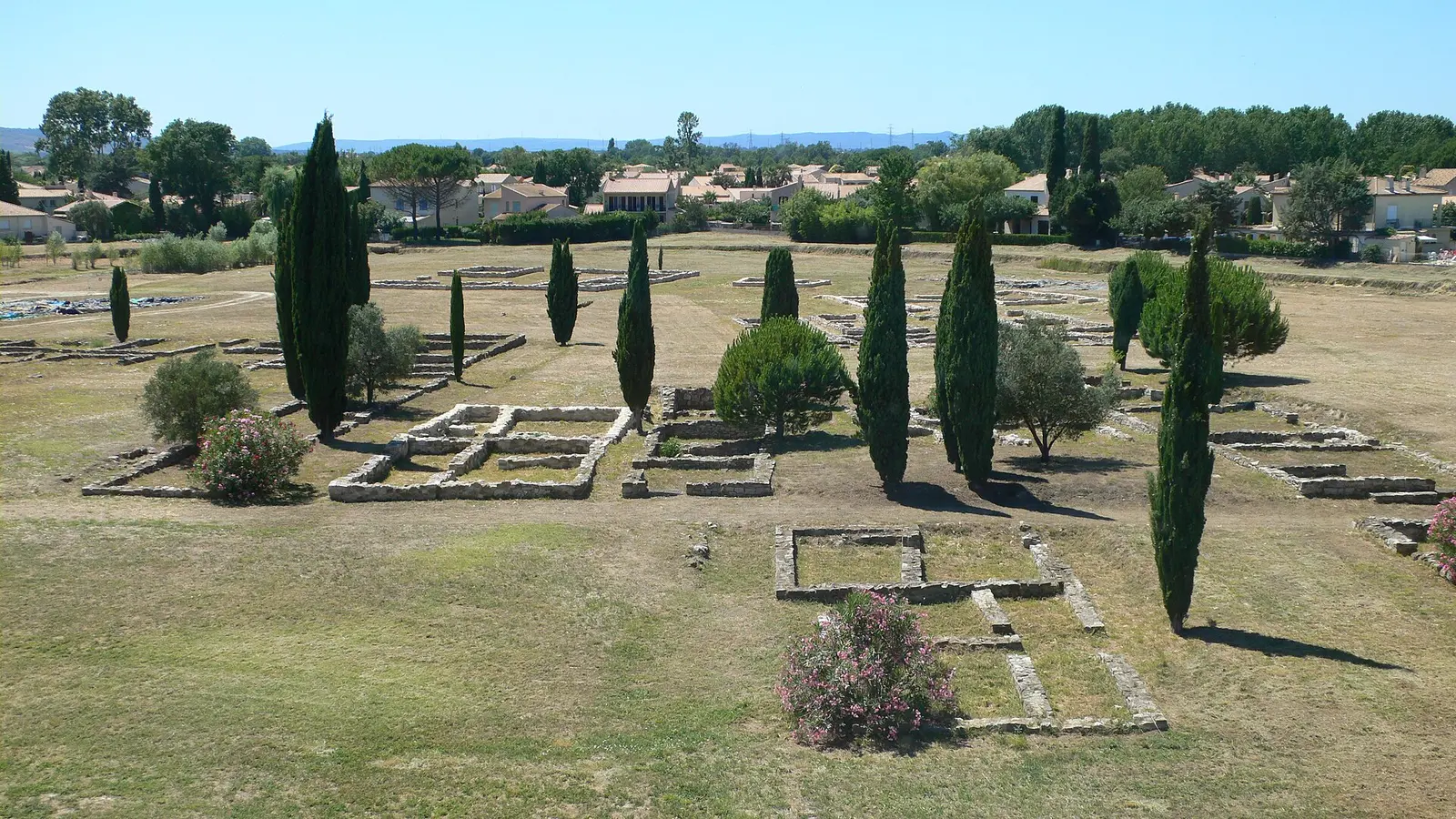
Lattara was a coastal port near Montpellier. Around 525 BCE, merchant quarters were built inside its walls, with access to a lagoon connected to the sea.3
Etruscan wine arrived in amphorae dated to about 525–475 BCE. Imports kept coming to Lattara even as they fell off at many other sites after about 525 BCE.3
The Etruscans had contact with Phoenicians by at least 800 BCE, and the Phoenician amphora was the model for the Etruscan one.3
The imported wine was flavored with pine resin and herbs, most likely rosemary and basil. Such additions may have served as preservatives or for medicinal reasons.3,4
Off the Hyères Islands east of Marseille, the Etruscan wreck Grand Ribaud F (c. 515–475 BCE) carried roughly 700–800 amphorae of the same type, sealed with cork. Its destination may well have been Lattara.3
A taste for imported Etruscan wine appears to have led to a local industry. By c. 425–400 BCE, people at Lattara were pressing grapes on a limestone platform built in a courtyard.3,4
McGovern suggests the Etruscans likely helped locals lay out vineyards, bringing domesticated vines by ship from central Italy. He calls the Lattara press the earliest native Celtic wine press found so far.2
How we know
Of 13 Etruscan amphorae from one storeroom, four were analyzed. Tartaric acid, a grape marker, was clearly present in some, and compounds from pine resin were found in all.3
The limestone press tested positive for tartaric acid. Several thousand charred grape seeds lay in a container from an earlier phase nearby, and no olive pits were found near the platform.3
The press has a spout and looks like wine presses painted on Greek vases. Science News reported it as the earliest molecular evidence of winemaking in France.4
The authors caution that tartaric acid can also come from grape juice, syrup or vinegar, and that absolute certainty is unattainable in this kind of chemistry.3
What it left behind
The Site archéologique Lattara – musée Henri Prades in Lattes presents the Gaulish port and its people, with the excavated site open to visitors.5
Lattara's museum is running a temporary exhibition on Mediterranean banquets among Greeks, Etruscans and Gauls from 5 June 2026 to 1 February 2027.5
In Italy, the Etruscan cemeteries of Cerveteri and Tarquinia are a UNESCO World Heritage Site. Tarquinia has some 200 painted tombs whose scenes show Etruscan daily life and beliefs.6
The place today: France.
Questions people ask
When did winemaking start in France?
The earliest chemical evidence is a limestone grape press at Lattara, near Montpellier, dated c. 425–400 BCE. Local winemaking was in place by at least the 5th century BCE.3
Who brought wine to France?
Wine first arrived in Etruscan amphorae from central Italy. Phocaean Greeks at Marseille also made wine jars from the late 6th century BCE.2,3
What was in the Etruscan wine?
Residues show grape wine with pine resin and herbs, most likely rosemary and basil.3,4
Can you visit Lattara?
Yes. The Site archéologique Lattara – musée Henri Prades in Lattes shows the excavated port and a museum of the site. It is closed on Tuesdays.5
Sources
- Etruscan Art (Heilbrunn Timeline of Art History), The Metropolitan Museum of Art (2004). Accessed 2026-11-18.
- Tracing The Origins Of French Winemaking (Science Friday), NPR via KCUR (2013). Accessed 2026-11-18.
- Beginning of viniculture in France, Proceedings of the National Academy of Sciences (via PubMed Central) (2013). Accessed 2026-11-18.
- Italians taught French wine-making, Science News (2013). Accessed 2026-11-18.
- Site archéologique Lattara – musée Henri Prades, Montpellier Méditerranée Métropole (2026). Accessed 2026-11-18.
- Etruscan Necropolises of Cerveteri and Tarquinia, UNESCO World Heritage Centre. Accessed 2026-11-18.