The people
- Amharic- and Tigrinya-speaking communities of Ethiopia and Eritrea: Honey wine is made locally in Ethiopia and Eritrea, where it is called tej in Amharic and mes (mess) in Tigrinya, and it is served mainly at social and religious ceremonies.1
- Tej bet keepers: Most tej houses are run by women, while most of their customers are men; in Lalibela, owners make tej with wildflower honey from local beekeepers.2
The story
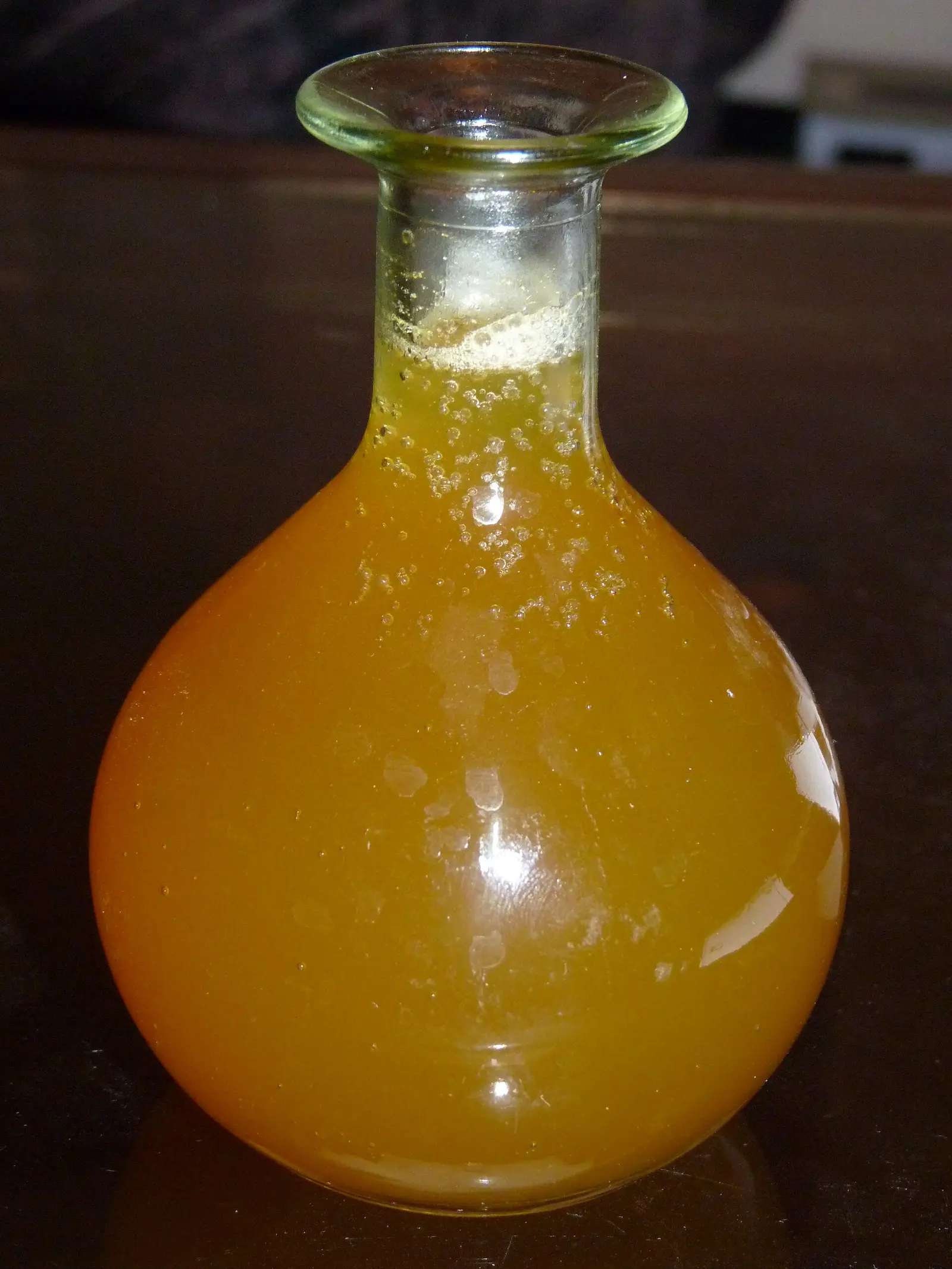
Tej is a traditional Ethiopian drink made from fermented honey and flavored with gesho (Rhamnus prinoides), a shrub whose leaves and stems give the drink its bitterness. STIAS researcher Berhanu Abegaz notes it is sometimes called honey wine.3,4
A 2025 review describes the method: honey and water are mixed and left for two to three days, filtered, then boiled gesho leaves and stems are added for a second fermentation of 8 to 21 days before a final filtering.4
Fermentation relies on the yeasts and lactic acid bacteria already present in the honey, pots and tools. Before reuse, the pot is seasoned by smoking it over glowing wild olive (Olea africana) and gesho.5
Tej was long tied to rank. In the 19th century it was the prized drink of Ethiopia's nobility and soldiers, and an Amharic saying contrasts tej for the nobles with cabbage for the poor.2
Tej is served in the berele, a round-bodied, long-necked glass flask. Because glass was not made in Ethiopia, berele were imported over the centuries, and the vessel's presence in the country is traced to the 14th century.6
The berele also carried political symbols. Some made during Haile Selassie I's reign bore the image of the Italian royal family and were later etched with a cross, and vessels with the Imperial Crown were reworked under the Derg.6
Today tej belongs to everyone. It is sold in tej bets, small honey-wine houses that are a center of neighborhood social life, where azmari minstrels play the masinko fiddle and sing.2,7
Honey wine also remains a ceremonial drink in Ethiopia and Eritrea, served mainly at social and religious ceremonies and popular during festivals and celebrations.1,7
How we know
Microbiologists have identified the yeasts that drive tej fermentation, including Saccharomyces cerevisiae and Kluyveromyces species, alongside Lactobacillus, Leuconostoc and Pediococcus bacteria.5
Ethnobotanists record that tej is made with chopped stems of Rhamnus prinoides or, in some places, the roots of a related shrub, R. staddo.1,4
Surveys of Ethiopian fermented drinks list tej in Amhara, Tigray and Addis Ababa, at 7 to 11% alcohol by volume, and estimate that about 80% of Ethiopia's honey goes into tej.4
Collections of berele flasks preserve the drink's material history. One collector's pieces, gathered over more than 35 years, include many made in Bohemia, in today's Czech Republic.6
What it left behind
In 2025 the Yimtubezina Museum and Cultural Centre in Addis Ababa's Friendship Park opened an exhibition of more than 150 berele, alongside paintings by contemporary Ethiopian artists.6
Tej bets remain part of daily life. Many in Addis Ababa carry playful names, some coined by customers, and in Lalibela, a name the Parts Unknown writer translates from Amharic as 'honey eater', tej houses use local wildflower honey.2
Tej shapes the Amharic word for grape wine: the word for grape is woin, and grape wine is called woin tej (or nebit). Grape wine is made commercially too, at the Awash winery, founded in 1956.3
Researchers warn that consumption is declining and that little has been done to preserve the knowledge of making honey wine, and they call for work to sustain it.1
Questions people ask
What is tej made from?
Honey, water and gesho (Rhamnus prinoides), a shrub whose boiled leaves and stems add bitterness. Natural yeasts and bacteria in the honey and pot ferment it.4,5
What is a tej bet?
A tej bet is a small house or bar that makes and sells tej. Most are run by women, and they are a center of social life, often with azmari musicians.2,7
What is a berele?
The berele is the round-bodied, long-necked glass flask tej is traditionally served in. The glass was imported, and the vessel is traced in Ethiopia to the 14th century.6
Sources
- Ethnobotanical knowledge and socioeconomic potential of honey wine in the Horn of Africa, Indian Journal of Traditional Knowledge 18(2), NOPR repository (2019). Accessed 2026-11-18.
- Tej bet: Ethiopia's honey-wine houses, Explore Parts Unknown (2018). Accessed 2026-11-18.
- Viniculture in Ethiopia, Stellenbosch Institute for Advanced Study (STIAS) (2021). Accessed 2026-11-18.
- A review on the microbiology of Ethiopian traditional fermented beverage products, Frontiers in Nutrition (2025). Accessed 2026-11-18.
- Microbiology of Ethiopian Traditionally Fermented Beverages and Condiments, International Journal of Microbiology (via PubMed Central) (2020). Accessed 2026-11-18.
- History in a Vessel: Tej and the Berelé, The Reporter Ethiopia (2025). Accessed 2026-11-18.
- An Everyman's Drink Descended From Ancient Royal Libations, Roads & Kingdoms (2016). Accessed 2026-11-18.